Bringing a medical device from concept to commercial production requires more than engineering expertise. Medical-device OEMs must align product architecture, electronics, software, usability, regulatory strategy, verification, supply-chain readiness, manufacturing processes, testing and post-launch support – often across multiple partners and markets.
This complexity is changing the way medical-device companies outsource. Instead of engaging separate suppliers for product design, regulatory documentation, electronics manufacturing, plastics, assembly and lifecycle support, many OEMs are evaluating medical device contract manufacturing companies that can assume broader responsibility across the product lifecycle.
The right partner, however, is not always the largest manufacturer. A diagnostic instrument, connected patient-monitoring platform, surgical system and drug-delivery device may each require a different combination of engineering depth, manufacturing technology, regulatory experience and production scale.
The following list covers ten notable organisations supporting medical-device development, industrialisation, manufacturing, testing, clinical or regulatory programmes.
What Is a Medical Device CDMO?
A medical-device CDMO, or Contract Development and Manufacturing Organisation, supports an OEM across both product development and manufacturing.
Depending on the company and programme, medical-device CDMO services may include:
- Product feasibility and requirements definition
- Industrial and mechanical design
- Electronics engineering
- Embedded software and firmware
- Systems engineering
- Prototyping
- Human factors and usability engineering
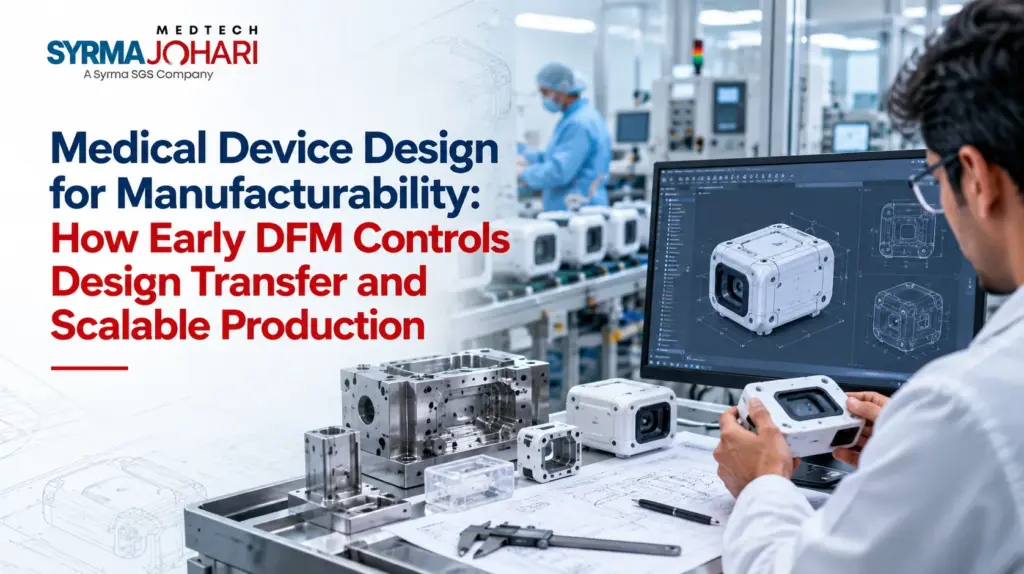
- Design for manufacturability
- Verification and validation
- Quality and regulatory documentation
- Tooling and process development
- Design transfer
- New Product Introduction (NPI)/ New Product Development (NPD)
- Pilot production
- Commercial-scale manufacturing
- Packaging, testing and sterilisation coordination
- Supply-chain management
- Value engineering
- Product sustenance
- Post-market and lifecycle support
A conventional medical-device contract manufacturer may primarily build an already-developed product. A full-service CDMO can become involved earlier-sometimes from the initial concept or prototype – and help transform it into a compliant, manufacturable and commercially scalable medical device.
CDMO vs Contract Manufacturer vs Engineering or Regulatory Partner
Not every organisation involved in medical-device outsourcing operates through the same business model.
Full-service MedTech CDMO
A full-service CDMO combines product development, engineering, industrialisation, manufacturing and, in some cases, quality and regulatory support.
Contract manufacturer or EMS provider
An electronics manufacturing services company typically focuses on PCB assembly, electromechanical integration, box build, testing, supply-chain management and scaled production. Some global EMS providers also offer extensive product-development services.
Product design and engineering company
An engineering specialist may support industrial design, embedded systems, software, usability, verification and product sustenance, while commercial manufacturing is managed by another organisation.
Regulatory, clinical or testing specialist
These organisations support regulatory strategy, quality systems, clinical evidence, biological safety, submissions and market access. They help medical-device companies prepare for approval and commercialisation, even when they do not provide large-scale manufacturing.
How the Companies Were Assessed
The companies were assessed across factors that influence medical-device programme fit, including:
- Medical-device industry experience
- Product-development capabilities
- Engineering depth
- Manufacturing technologies
- Quality and regulatory systems
- Design-transfer and NPI support
- Electronics and electromechanical expertise
- Testing and clinical capabilities
- Supply-chain management
- Production scalability
- Geographic reach
- Product sustenance and lifecycle support
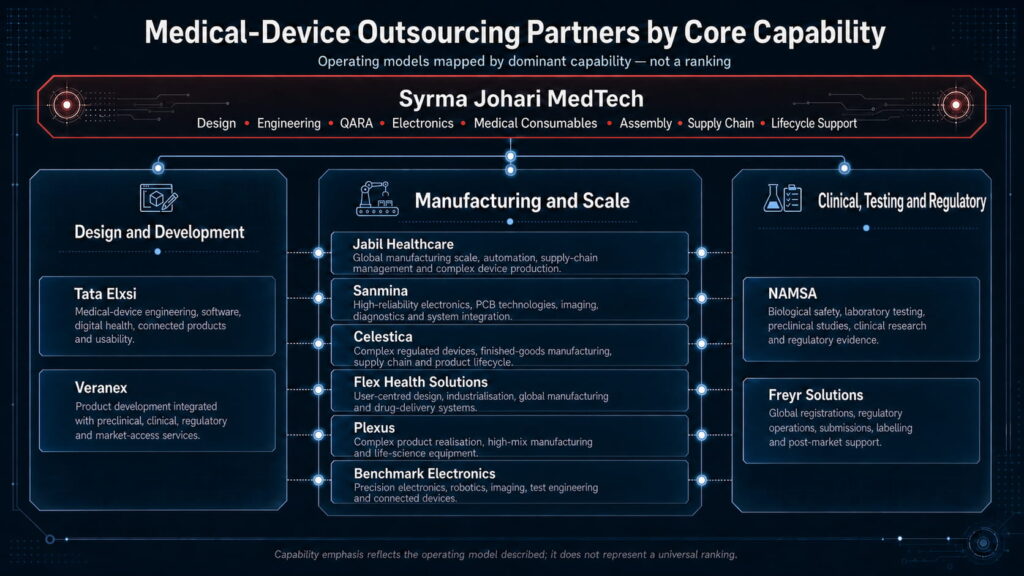
The order provides a structured industry overview rather than a universal recommendation. The most appropriate partner will depend on the product, intended markets, development stage and required engagement model.
Top 10 Medical Device Contract Manufacturing Companies and MedTech CDMO Partners
1. Syrma Johari MedTech
Operating model: End-to-End Solution Provider, Concept to Commercialization
Global footprint: A strong operational base across India, supported by manufacturing capabilities in Europe and business operations in the United States.
Relevant for programmes involving: Integrated product development, design and engineering, regulatory readiness, manufacturing transfer, India-based production and lifecycle support
Syrma Johari MedTech supports medical-device companies from early development through regulated manufacturing and lifecycle management. Its operating model combines medical device design and engineering services, quality and regulatory support, electronics manufacturing, plastics, device assembly and supply-chain capabilities within a MedTech-focused ecosystem.
Core capabilities
Its product-development capabilities include:
- Requirements mapping and feasibility assessment
- Industrial and mechanical design
- Electronics engineering
- Embedded software and firmware
- Systems engineering
- Product architecture
- Prototype development
- Design for manufacturability
- Verification and validation
- Test-fixture development
- Design transfer and production readiness
The company’s medical device contract manufacturing services include medical PCB assembly, cable harnesses, electromechanical integration, box build, medical-grade plastics, precision metal fabrication, optics assembly, device testing, controlled-environment production, sterilisation coordination and supply-chain management. Its capabilities support Class I, II and III medical devices across diagnostics, patient monitoring, drug delivery, critical care, IVD, rehabilitation, medical aesthetics and surgical platforms.
Its medical device compliance services cover areas such as design controls, quality-management systems, risk management, regulatory submissions, clinical and performance evaluation, CAPA, labelling and post-market surveillance.
Medical-device areas supported
SJML’s programme experience spans:
- Patient-monitoring and home-health devices
- Point-of-care diagnostic systems and readers
- Laboratory and IVD instruments, including diagnostic analysers
- Diagnostic consumables, fluidic components and associated disposables
- Medical-aesthetics devices
- Energy-based therapeutic equipment
- Critical-care and life-support systems
- Surgical and interventional equipment
- Drug-delivery devices
- Connected medical products
- Microfluidic platforms, cartridges and consumables
Programme-fit considerations
The integrated model may be relevant where an OEM needs to:
- Convert a prototype into a production-ready device
- Transfer manufacturing from another supplier
- Redesign a product for manufacturability or cost
- Combine electronics, firmware, mechanics and plastics
- Scale instruments and consumables together
- Consolidate multiple development and manufacturing suppliers
- Establish a second source in India
- Localise a device for the Indian market
- Sustain a mature or obsolescence-prone product
Its medical device lifecycle management offering includes component-obsolescence management, controlled redesign, compliance continuity and manufacturing support for in-market products.
For OEMs evaluating regional manufacturing diversification, its Make in India MedTech programme combines development, localisation, regulatory support and production for domestic and global markets.
2. Jabil Healthcare
Operating model: Global healthcare manufacturing solutions provider
Headquarters: United States
Relevant for programmes involving: Large-scale manufacturing, automation, global supply chains and multi-region production
Jabil Healthcare provides development and advanced manufacturing services across medical devices, diagnostics, drug-delivery systems and connected healthcare.
Its medical-device capabilities cover surgical instruments, capital equipment, patient-monitoring products, chronic-disease-management devices, digital-health technologies and associated consumables. Jabil also offers design engineering, new product introduction, tooling, plastics, automation, supply-chain development and product-lifecycle services.
The company has a broad international manufacturing network and operates multiple facilities certified for regulated healthcare production. It is particularly relevant for OEMs that need industrial-scale manufacturing, automated production and coordinated sourcing across several regions.
Distinctive strengths
- Global manufacturing capacity
- High-volume production
- Automation
- Tooling and injection moulding
- Advanced supply-chain management
- Complex device and consumable manufacturing
- Product-lifecycle support
Programme fit: Large or multinational medical-device programmes requiring extensive capacity, automation and multi-region supply-chain execution.
3. Sanmina
Operating model: Global EMS and integrated design-and-manufacturing company
Headquarters: United States
Relevant for programmes involving: Complex medical electronics, imaging systems, laboratory equipment and high-reliability electromechanical products
Sanmina designs and manufactures complex electronic and mechanical products for medical and other highly regulated industries.
Its medical portfolio includes ultrasound systems, CT and MRI equipment, X-ray platforms, patient monitors, diagnostic systems, surgical equipment, laboratory instruments and personal-use medical devices. The company’s capabilities include design, prototyping, PCB technologies, PCBA, precision mechanical systems, full-system integration, testing, logistics and repair.
Sanmina’s model is particularly relevant to products where electronics, mechanical structures, test systems and traceability must be tightly integrated.
Distinctive strengths
- Complex medical electronics
- Advanced PCB capabilities
- System-level manufacturing
- Diagnostic and imaging equipment
- Precision mechanical integration
- Automated and semi-automated production
- Global fulfilment and repair
Programme fit: Imaging, diagnostics, laboratory systems, patient-monitoring equipment and other electronics-intensive devices.
4. Celestica
Operating model: Design, engineering, manufacturing and product-lifecycle partner
Headquarters: Canada
Relevant for programmes involving: Complex regulated devices, finished-goods manufacturing and global product-lifecycle support
Celestica’s HealthTech business supports medical-device OEMs across engineering, manufacturing, supply-chain management and lifecycle services.
The company states that it has experience with Class II and Class III medical devices, from high-level assembly through finished products, and operates ISO 13485-certified and FDA-registered environments. Its applications include surgical technologies, medical imaging, diabetes care and in-vitro diagnostics.
Celestica may be particularly relevant when an OEM requires a combination of advanced manufacturing, supplier-network management, finished-device production and long-term product support.
Distinctive strengths
- Design-led manufacturing
- Class II and Class III device experience
- Finished-goods production
- Global supply-chain orchestration
- Product industrialisation
- Lifecycle and sustainment support
- Complex medical-system manufacturing
Programme fit: Established OEM programmes involving sophisticated devices, global sourcing and extended product lifecycles.
5. Flex Health Solutions
Operating model: Global design, engineering, manufacturing and supply-chain partner
Headquarters: Singapore
Relevant for programmes involving: Product industrialisation, manufacturing ramp-up, connected devices and drug-delivery systems
Flex Health Solutions supports medical equipment, medical devices and drug-delivery programmes.
Its services include user-centred design, product engineering, human-factors support, new product introduction, advanced manufacturing, vertically integrated production and global supply-chain management. Flex reports more than three decades of experience across medical equipment, devices and drug-delivery products.
The organisation is relevant across connected-health technologies, diagnostics, patient monitoring, consumer-health products and drug-delivery platforms.
Distinctive strengths
- Design-to-scale execution
- Human-factors engineering
- Manufacturing ramp-up
- Connected-health devices
- Drug-delivery products
- Advanced manufacturing
- Global supply-chain management
Programme fit: Multinational programmes moving from advanced development into regional or global commercial production.
6. Plexus
Operating model: Product-realisation and manufacturing partner
Headquarters: United States
Relevant for programmes involving: Complex, high-mix, low-to-medium-volume devices and life-science instruments
Plexus offers services across the product lifecycle, from design and development through manufacturing and aftermarket support.
Its healthcare and life-sciences activities include medical equipment, diagnostics, laboratory systems, advanced surgical products, medical robotics, therapeutic systems and imaging technologies. Plexus describes its offering as flexible engagement across the full medical-device lifecycle.
The company is particularly relevant to technically demanding programmes where close engineering collaboration, controlled production and long product lifecycles are critical.
Distinctive strengths
- Integrated product realisation
- Complex product development
- Design for manufacturability
- High-mix manufacturing
- Life-science instrumentation
- Cleanroom production
- Aftermarket and lifecycle services
Programme fit: Diagnostic instruments, surgical systems, laboratory platforms and specialised medical equipment.
7. Veranex
Operating model: MedTech innovation CRO
Headquarters: United States
Relevant for programmes involving: Product development, preclinical work, clinical research, regulatory strategy and market access
Veranex combines product design and engineering with preclinical, clinical, quality, regulatory and commercialisation services.
It positions itself as an integrated innovation CRO for medical devices and diagnostics, supporting programmes from early product definition through evidence generation and market launch. Its capabilities include engineering, human factors, testing, regulatory consulting, clinical-trial support and market-access planning.
Veranex is therefore more accurately considered a development and commercialisation partner than a direct equivalent to a global high-volume EMS manufacturer.
Distinctive strengths
- Medical-device product development
- Human factors
- Preclinical research
- Clinical-trial strategy and execution
- Regulatory consulting
- Quality support
- Market access and commercialisation
Programme fit: Innovative medical devices requiring coordinated engineering, clinical, regulatory and evidence-generation workstreams.
8. Benchmark Electronics
Operating model: Engineering-led EMS and advanced manufacturing partner
Headquarters: United States
Relevant for programmes involving: Medical robotics, imaging, connected devices, fluid management and complex electronics
Benchmark provides product engineering, test development, precision manufacturing and system-level production for medical technologies.
Its areas of focus include connected medical devices, energy-delivery systems, fluid management, medical robotics, optical imaging and radiological imaging. Benchmark also supports embedded software, electronics, optics, automation, precision machining and electromechanical integration.
The organisation is relevant where engineering, test strategy, precision components and regulated assembly must be delivered within one product-realisation framework.
Distinctive strengths
- Medical robotics
- Optical and radiological imaging
- Precision manufacturing
- Connected-device engineering
- Test development
- Embedded systems
- Complex electromechanical integration
Programme fit: Imaging platforms, robotic systems, connected devices, fluid-management systems and advanced life-science equipment.
9. Tata Elxsi
Operating model: Medical-device design, engineering and digital-health specialist
Headquarters: India
Relevant for programmes involving: Software-intensive devices, connected health, digital workflows, imaging and user-centred development
Tata Elxsi provides medical-device engineering across product strategy, industrial design, embedded systems, software, AI-enabled healthcare, digital health, verification, validation and sustenance.
Its medical-device engineering framework extends from requirements and concept development to production readiness. The company also offers value engineering, regulatory-support activities, robotics, automation and product-lifecycle services.
Tata Elxsi is particularly relevant where user experience, software, connectivity, imaging, data or digital workflows represent a substantial portion of the product.
Distinctive strengths
- Industrial and user-experience design
- Embedded software
- Digital health
- Connected medical devices
- AI-enabled healthcare systems
- Verification and validation
- Sustenance and value engineering
Programme fit: Connected devices, imaging systems, digital-health platforms and software-intensive medical technologies.
10. NAMSA
Operating model: Medical-device testing, clinical and regulatory CRO
Headquarters: United States
Relevant for programmes involving: Biological safety, preclinical testing, clinical evidence and regulatory submissions
NAMSA provides testing, preclinical research, clinical studies, regulatory consulting, quality services, reimbursement support and IVD expertise.
Its services are especially important where an OEM must establish biological safety, generate scientific or clinical evidence, prepare a testing programme or support a regulatory submission. NAMSA describes its offering as full-development-lifecycle support for medical-device sponsors.
NAMSA is not a conventional medical-device contract manufacturer. It may instead complement a design or manufacturing partner by supplying specialist laboratory, preclinical and clinical capabilities.
Distinctive strengths
- Medical-device testing
- Chemical characterisation
- Biocompatibility and biological safety
- Preclinical research
- Clinical trials
- Regulatory consulting
- IVD services
Programme fit: Devices requiring structured testing strategies, biological evaluation, clinical studies or regulatory evidence.
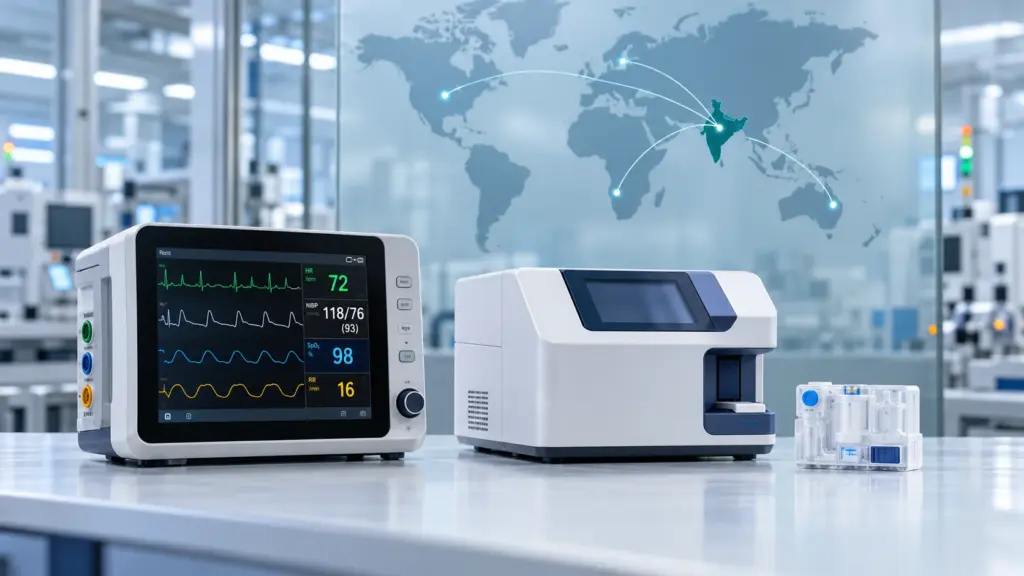
Medical-Device Partner Landscape
How to Select the Right Medical Device Contract Manufacturing Company
A company’s reputation or global footprint alone does not establish programme fit. OEMs should examine the following areas carefully.
Product and technology alignment
Determine whether the partner has relevant experience in the product type and the technologies required.
A connected monitoring device may require embedded firmware, wireless connectivity, cybersecurity and cloud integration. An IVD system may require fluidics, optics, analyser electronics, reagents and consumable manufacturing.
Development-stage fit
Some companies are strongest in concept and product development. Others are structured primarily for design transfer and commercial production.
Establish:
- What technical inputs the partner expects
- Which development activities it owns
- Whether the design is production-ready
- Who controls the design history and technical documentation
- What happens if redesign is required before transfer
Quality and regulatory readiness
Confirm:
- Applicable quality certifications
- Certification scope
- Relevant manufacturing site
- Device-class experience
- Design-control procedures
- Risk-management practices
- Traceability systems
- CAPA and change controls
- Audit readiness
- Target-market regulatory experience
A certification held by one facility should not automatically be assumed to apply across the company’s global network.
Design-transfer and NPI process
A structured design-transfer process should cover:
- Product requirements
- Bill of materials
- Drawings and specifications
- Critical-to-quality characteristics
- Supplier qualification
- Tooling
- Inspection methods
- Test systems
- Process validation
- Pilot builds
- Yield improvement
- Production-release criteria
Manufacturing technology
Assess whether the proposed facility can support the required processes, such as:
- PCB assembly
- Cable harnesses
- Precision machining
- Injection moulding
- Blow moulding or extrusion
- Optics
- Cleanroom assembly
- Welding or bonding
- Fluidic integration
- Automated testing
- Packaging
- Sterilisation coordination
Production scale
A startup manufacturing its first 500 units has different requirements from an established OEM producing hundreds of thousands of devices annually.
The partner should be able to support the appropriate combination of prototype, pilot, ramp-up and mature production without forcing the programme into an unsuitable operating model.
Supply-chain resilience
Evaluate:
- Supplier qualification
- Alternate-source development
- Component traceability
- Obsolescence monitoring
- Inventory policies
- Logistics
- Continuity planning
- Geographic concentration risk
Programme governance
The engagement should define:
- Scope ownership
- Decision rights
- Milestones
- Deliverables
- Escalation mechanisms
- Engineering-change control
- Commercial change procedures
- Risk registers
- Performance metrics
- Communication cadence
Lifecycle support
Medical devices often remain in the market for many years. Determine whether the partner can support:
- Component obsolescence
- Design changes
- Cost optimisation
- Supplier changes
- Complaint investigation
- Revalidation
- Regulatory updates
- Sustaining engineering
- Post-market documentation
Questions to Ask a Prospective MedTech CDMO
- Which parts of the product lifecycle do you manage internally?
- Have you supported comparable technologies or device classifications?
- Which facility would manufacture the product?
- Which certifications apply specifically to that facility?
- Who owns the product architecture and design records?
- How are design controls and risk management handled?
- What is your design-transfer and NPI process?
- Can you support prototype, pilot and commercial volumes?
- Which manufacturing processes are internal?
- Which processes are outsourced?
- How are suppliers qualified and monitored?
- How is component traceability maintained?
- What verification and validation capabilities are available?
- Can you design and build production test systems?
- How are engineering changes governed after launch?
- How do you manage component obsolescence?
- What programme-management model will be used?
- How will intellectual property and confidential data be protected?
- Can you support regulatory documentation and registrations?
- What lifecycle and aftermarket services are available?
When an Integrated CDMO Model Creates the Most Value
An integrated development-and-manufacturing model may create particular value when:
- An early prototype must become a production-ready device
- The existing design has cost or manufacturability issues
- Manufacturing is being transferred from another supplier
- Electronics, software, mechanics and plastics must be integrated
- Too many disconnected suppliers are involved
- A second manufacturing source is required
- Diagnostic instruments and consumables must scale together
- Engineering changes affect regulatory documentation
- A mature device requires value engineering
- Component obsolescence threatens production continuity
- The OEM wants to establish production in India
- Commercial manufacturing capacity is required without significant internal investment
The main benefit is not simply supplier consolidation. When engineering, compliance, sourcing and manufacturing teams work through a coordinated programme, design decisions can be assessed earlier for technical risk, regulatory impact, validation requirements and production cost.
Conclusion
There is no universally suitable medical-device contract manufacturer or MedTech CDMO.
The right partner depends on:
- Product complexity
- Development maturity
- Intended use
- Device classification
- Regulatory pathway
- Required technologies
- Production volume
- Target geographies
- Supply-chain strategy
- Testing and clinical needs
- Long-term lifecycle objectives
Large global manufacturing organisations such as Jabil, Sanmina, Celestica and Flex offer extensive production scale and supply-chain reach. Plexus and Benchmark are relevant to complex, engineering-intensive devices. Tata Elxsi is strongly aligned with digital, connected and software-led products. Veranex and NAMSA support development, clinical, testing and regulatory workstreams that may sit alongside manufacturing.
For programmes requiring a combination of development, regulatory readiness, electronics, plastics, assembly and India-based manufacturing, an integrated MedTech CDMO model may reduce supplier handoffs and simplify accountability across the product lifecycle. Organisations evaluating such a model can contact Syrma Johari MedTech to discuss product-development, manufacturing-transfer, localisation or lifecycle requirements.
Frequently Asked Questions
What is a medical-device CDMO?
A medical-device CDMO is an outsourced partner that supports product development as well as manufacturing. Its services may include engineering, prototyping, design for manufacturability, verification, regulatory support, design transfer, pilot production, commercial manufacturing and lifecycle management. The exact scope varies substantially between providers.
What does a medical-device contract manufacturer do?
A medical-device contract manufacturer builds products on behalf of an OEM. Services may include component sourcing, PCB assembly, plastics, machining, device assembly, testing, packaging, process validation and supply-chain management. Some manufacturers also provide product-development and regulatory-support services.
What is the difference between a CDMO and an EMS company?
An EMS company traditionally focuses on electronics manufacturing, including PCB assembly, box build, testing and supply-chain services. A CDMO generally assumes broader responsibility across development, industrialisation and manufacturing. The distinction is not absolute because several large EMS providers now offer design and product-lifecycle services.
How should an OEM select a medical-device manufacturing partner?
The OEM should assess product and technology fit, site-specific certifications, engineering capability, design-transfer processes, manufacturing technologies, production scale, supply-chain controls, regulatory-market experience, programme governance, intellectual-property protection and lifecycle support.
What certifications should a medical-device manufacturer have?
ISO 13485 is a central quality-management-system standard for medical-device organisations. Other requirements depend on the device, manufacturing process and target market. OEMs should verify the scope, issuing body, relevant facility and manufacturing activities covered by each certificate.
Can one company support both development and manufacturing?
Yes. Integrated MedTech CDMOs may support concept development, engineering, verification, design transfer, manufacturing and lifecycle services. This can reduce supplier handoffs, although design ownership, regulatory responsibility and programme governance must still be clearly defined.
Why are global OEMs considering medical-device manufacturing in India?
India offers engineering talent, electronics-manufacturing capacity, an expanding medical-device ecosystem and opportunities for supply-chain diversification. The business case should assess technology, supplier availability, quality systems, logistics, regulatory requirements and total cost rather than focusing only on labour costs.
When should a medical-device company transfer production?
Typical triggers include capacity constraints, supply-chain risk, geographic diversification, cost pressure, product redesign, supplier consolidation and the need for stronger lifecycle support. A successful transfer requires controlled documentation, tooling management, supplier qualification, process validation and regulatory-impact assessment.
Can a CDMO support a medical device after launch?
Many CDMOs provide sustaining engineering, complaint support, design changes, component-obsolescence management, value engineering, supplier changes, verification, documentation updates and ongoing manufacturing. These services are especially important for devices with long commercial lifecycles.