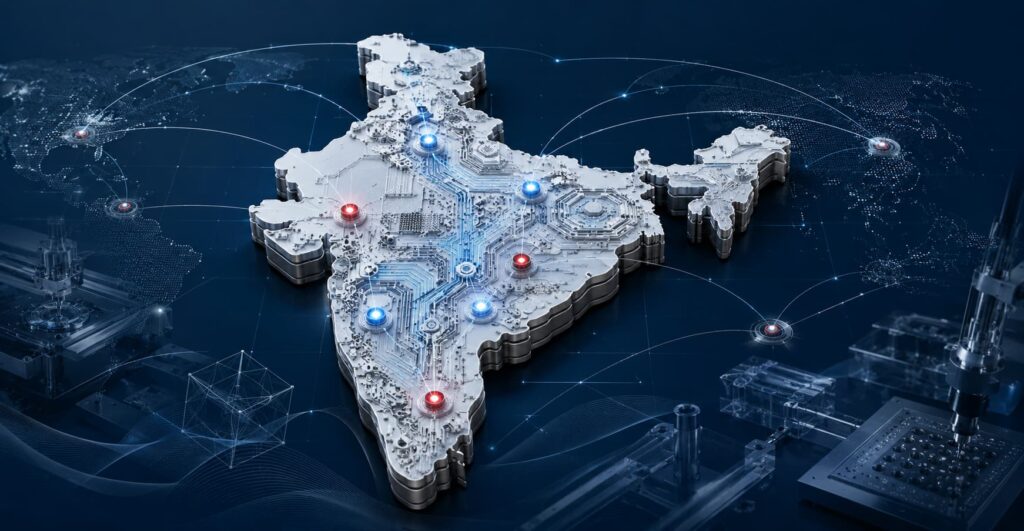
The changing realms of medical device manufacturing in India tend to favor small and big size medical device manufacturers. The Indian government has cleared numerous roadblocks in the process to scale up & attract investments from around the globe. Niti Aayog, the think tank of India is developing strategies to culminate a bigger portfolio and generate higher revenue from medical device manufacturing.
Under the Make in India initiative, the government has planned to set up their manufacturing clusters in several states across the nation. To acknowledge and address the growing concerns of the medical device market, it’s important to find a way to manufacture cost-optimized solutions at a reasonable price.
The dynamic shift in the global outlook of the country catalyzes the process of driving bigger medical manufacturing giants in India.
In 2023, the Union Cabinet approved the National Medical Devices Policy (NMDP), 2023 – the first dedicated national policy for the sector. It sets out a roadmap to grow India’s medical device industry from roughly $11 billion to $50 billion by 2030, and targets a 10–12% share of the global medical device market over the next 25 years, alongside reducing import dependence. The policy works alongside – not instead of – existing programs like Make in India and Atmanirbhar Bharat. To see how SJML is building for this next phase of India’s manufacturing growth, take a look at our Make in India initiative.
Why Are Global MedTech Companies Considering India for Manufacturing?
Several structural factors are strengthening India’s position as a MedTech manufacturing destination:
- A growing domestic manufacturing ecosystem – Government initiatives such as the Promotion of Medical Device Parks scheme and Production Linked Incentive (PLI) schemes are supporting common testing infrastructure, manufacturing capacity, and economies of scale across the medical device sector.
- Policy support for local manufacturing – The National Medical Devices Policy, 2023 focuses on regulatory streamlining, infrastructure development, R&D and innovation, investment attraction, and human-resource development to strengthen India’s MedTech manufacturing ecosystem.
- Greater ease of investment and contract manufacturing – India allows 100% Foreign Direct Investment (FDI) under the automatic route for medical device manufacturing, creating a more accessible environment for global OEMs evaluating manufacturing and contract manufacturing operations in the country.
- Development of specialised MedTech talent – India’s medical device policies increasingly emphasise technical education, skilling, and capacity building to strengthen capabilities across medical device design, development, engineering, and manufacturing.
- Deeper localisation of components and supply chains – Government programs are encouraging domestic production of key medical device components, raw materials, and accessories, helping build a more integrated local supply chain and reduce dependence on imported inputs.
- Improving export-market potential – India and the European Union concluded negotiations for the India–EU Free Trade Agreement on January 27, 2026. According to the Government of India, the combined EU pharmaceutical and medical devices market is valued at approximately $572.3 billion, creating significant future export potential for Indian manufacturers once the agreement enters into force.
Together, these developments are making India increasingly relevant for global MedTech companies evaluating manufacturing diversification, localisation, supply-chain resilience, and long-term production capabilities.
6 Reasons to Choose India as a Medical Device Manufacturing Destination
1. Strict Policies for Intellectual Property Rights and Data Security
Data is the new generation “Gold”, Indian engineering companies understand the value of data and the role it could play in maximizing the output. The global presence of reliable outsourcing partners has transformed the manufacturing pace in India. With experts and extensive multilayered security systems to detect data theft, most manufacturing companies are protected from data theft cybersecurity attacks. The key hygiene norms for protecting data include biometric access, server scans for penetration testing, encrypted computing devices, and advanced firewalls prominent in all the manufacturing units.
Trade-Related Aspects of Intellectual Property Rights (TRIPS) Agreement and the Patents (Amendment) Act, 2005 – which amended the Patents Act, 1970 to bring India into TRIPS compliance – introduced the grant of product patents for medical devices and pharmaceuticals.
India’s data protection framework has also matured considerably. The Digital Personal Data Protection (DPDP) Act, 2023 – India’s first comprehensive personal data law – had its implementing Rules notified in November 2025, with the Data Protection Board of India now operational and full compliance obligations (consent, breach notification, security safeguards) phasing in through May 2027. For global OEMs evaluating outsourcing partners, this gives India a codified, enforceable data-protection regime, on top of the manufacturing-floor security practices described above and SJML’s own regulatory and compliance services covering ISO 13485, EU MDR, and FDA 21 CFR Part 820 requirements.
2. Skilled Human Resource & Low Operations Cost
India has highly skilled and talented professionals from prestigious institutions contributing to the R & D sector. Annually, lakhs of young talented professionals are looking for enriching opportunities to join the force. The skilled labor at a reasonable cost can significantly benefit the medical device manufacturing companies looking for setting up operations in India.
3. PLI (Production Linked Incentive) Scheme
The Production Linked Incentive (PLI) Scheme for Promoting Domestic Manufacturing of Medical Devices was introduced by the Government of India to strengthen domestic manufacturing capabilities and attract investment in high-value medical devices. Under the original scheme eligibility criteria, an applicant company registered in India was required to have a minimum net worth of ₹18 crore, including group companies. The scheme applies to greenfield manufacturing projects, with eligible applicants required to meet prescribed investment and incremental sales thresholds to receive incentives. In 2023, the government introduced a Category B stream with lower minimum sales thresholds to encourage wider participation in the scheme.
The scheme runs from FY 2022–23 to FY 2026–27 with a total outlay of ₹3,420 crore, offering a 5% incentive on incremental sales of eligible devices for five years. As of September 2025 government disclosures, 32 applicants have been approved and 22 greenfield projects commissioned, bringing production of 55 devices online in India – including MRI scanners, CT scanners, mammography systems, C-arm X-ray machines, and ultrasound equipment that were previously import-dependent. Cumulative sales under the scheme have crossed ₹12,300 crore, including over ₹5,800 crore in exports. Because this window closes in FY2026-27, companies evaluating India for greenfield medical device manufacturing have a narrowing runway to benefit from this specific incentive.
4. Make in India & Aatmanirbhar Bharat Abhiyaan
The Govt. of India adheres to the mission of “Make in India” and after the COVID-19 pandemic, the stress on promoting medical device manufacturing under the same will be significant.
This push has since been formalized further under the National Medical Devices Policy, 2023, which explicitly builds on Make in India and Atmanirbhar Bharat, alongside 100% FDI permitted under the automatic route for the medical devices sector – removing prior approval requirements for most foreign investment into Indian manufacturing. SJML’s own Make in India initiative is built around this same momentum, helping global OEMs localize development, manufacturing, and supply chains in India.
5. Robust Ecosystem to Scale Production
The surroundings are rapidly evolving with productive, innovative, and safer shop floors. Harnessing the new generation technologies like IoT, the supply chain has reached the next level. The tracking is extremely simple and easy. The incoming of raw materials, production, and shipment are all kept in line maintaining the balance.
By partnering with an engineering company in India, the partners get everything from skill to scale under one umbrella. Thus, it’s a symbiotic growth leveraging human potential & technology at its best.
6. Medical Device Parks
The government of India has established a scheme to set up a medical device manufacturing ecosystem in India. The grant under the scheme will include world-class standard testing and infrastructure facilities in India. The primary goal is to reduce the medical device manufacturing cost, promote accessibility and enhance the overall affordability ratio in the country.
The Government of India introduced the Promotion of Medical Device Parks Scheme to strengthen the domestic medical device manufacturing ecosystem by developing common infrastructure and testing facilities. The scheme is intended to reduce manufacturing costs, improve access to shared facilities, and enhance the competitiveness of medical device manufacturers in India. Under the scheme, three Medical Device Parks are being developed in Greater Noida, Uttar Pradesh; Ujjain, Madhya Pradesh; and Kanchipuram, Tamil Nadu, with a Central grant-in-aid of ₹100 crore for each park. As per the Government of India’s 2026 update, these parks are at an advanced stage of development and are being equipped with common infrastructure that can support medical device manufacturing, testing, validation, and related activities.
Some of the features under common infrastructure parks:
- Component testing center/ESDM/PCB/Sensor’s facility
- Electra magnetic compatibility center and Electra magnetic interference.
- The accelerated centers for biocompatibility, biomaterial, and accelerated aging center.
- 3D printing & designing for medical-grade products.
- Common warehouse & logistics
- Solid waste management systems
India’s Medical Device Industry: Market Size and Growth Outlook
India’s medical device market has grown from roughly $11 billion in 2020 to an estimated $15+ billion today, and is projected to reach $50 billion by 2030 under the National Medical Devices Policy’s targets. India remains the 4th-largest medical device market in Asia and among the top 20 globally – with 100% FDI allowed under the automatic route, making it straightforward for global OEMs and CDMOs to set up wholly-owned manufacturing operations rather than requiring a joint venture.
What makes Syrma Johari MedTech (SJML) the best medical device manufacturing partner in India?
Syrma Johari MedTech (SJML) brings experience across key MedTech segments, including Diagnostics, Medical Aesthetics, Patient Monitoring, Surgical & Interventional Care, Critical Care, and Rehabilitation & Physical Therapy. Across these segments, SJML supports medical device programs through integrated design and engineering, manufacturing, regulatory compliance, and product lifecycle capabilities. The following strengths demonstrate SJML’s experience and positioning as a MedTech manufacturing partner.
Strong Regulatory Landscape
Generally, the major hindrance while looking in India for medical device manufacturing is the lack of appropriate strong regulations. The SJML facility is compliant with ISO13485: 2016 and MDSAP. Maintaining quality as the backbone at every level of manufacturing makes SJML a reliable manufacturing partner. Potential expertise spans across multiple regulatory jurisdictions such as US FDA (mainly CDRH), EU/CE and MDSAP etc. Our dedicated compliance and regulatory affairs services support OEMs through classification, submissions, and post-market surveillance across all these jurisdictions.
Expansive Capabilities
SJML has a vast array of capabilities required to take manufacturing to the next level. SJML is trusted by various multiple giants across the globe to manufacture world-class medical devices in different ranges and types. Our journey began with hearing-aid manufacturing in 1979, and over 45+ years of expertise in ideation, design, manufacturing, assembly, packaging, and delivery make us reliable. Also, our vendor network across the globe makes our supply chain efficient even in hard times. We are incorporating automation at every level to reduce costs and make processes more efficient and less time-consuming.
Cost-optimized Manufacturing
Our decades of experience in the medical device industry dynamics have given us enough insights into how to minimize cost while working on big projects. We ensure quality and cost optimization at its best.
Conclusion
The coming years after the global pandemic havoc have created a massive demand for quality medical device manufacturing. The Indian manufacturing industry will be a promising breeding ground for numerous med-tech startups and manufacturing companies. Also, the government schemes for establishing deeper connections with existing market will attract numerous medical giants to set up functions in India.
With the National Medical Devices Policy, 2023 now in place alongside the PLI scheme, an expanding medical device park network, a matured data-protection law, and new trade access via the India–EU FTA, the policy and infrastructure groundwork that this blog described in 2021 has moved from intent to measurable execution – reinforcing India’s case as a long-term, not just cost-driven, medical device manufacturing destination.