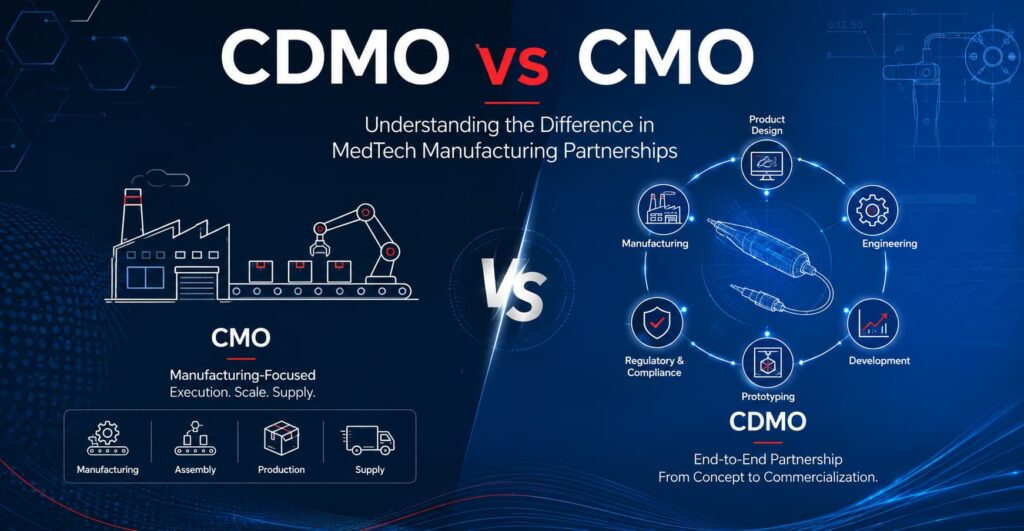
Medical outsourcing has become a key strategy for medical device companies. As product pipelines expand, companies increasingly turn to specialized partners for technical and manufacturing expertise.
The complexities of medical device development begin well before manufacturing. From the early stages of conceptualization, companies must navigate challenges across engineering, design, manufacturing, regulatory compliance, and scalability. These companies often face an important outsourcing decision: should they partner with a contract manufacturing organization (CMO) to manufacture an established design, or a contract development and manufacturing organization (CDMO) to support both product development and manufacturing.
This choice can ultimately influence development timelines, program costs, regulatory readiness, and speed to market. An integrated approach, such as SJML’s CDMO model, brings development and manufacturing capabilities together to create greater continuity across the product lifecycle.
What is the difference between a CDMO and a CMO?
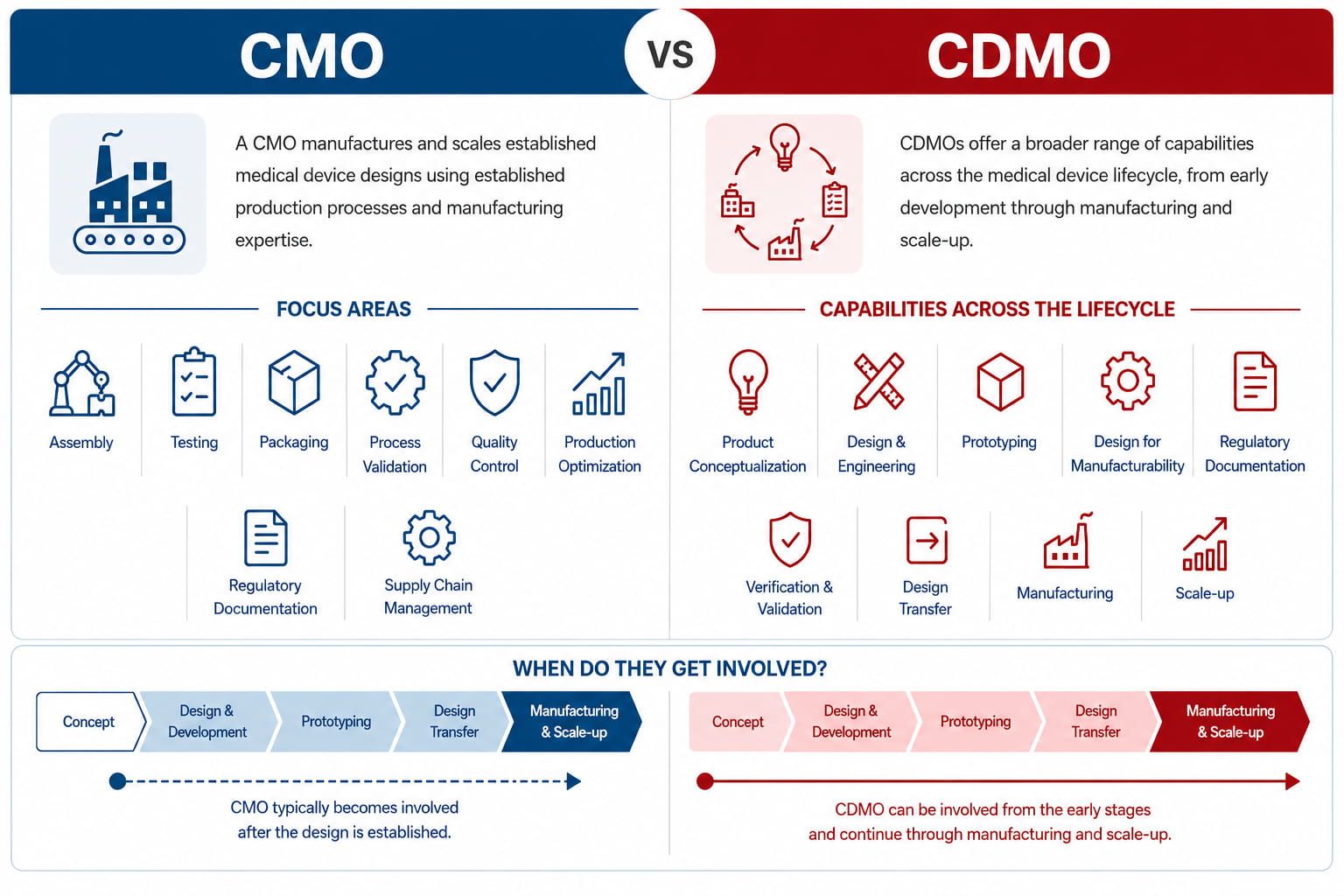
For medical device companies, outsourcing can extend well beyond manufacturing. A CMO can manufacture and scale established medical device designs using established production processes and manufacturing expertise. It focuses on aspects such as assembly, testing, packaging, and process validation, quality control, and production optimization. CMOs may also support supply chain management and capacity expansion, helping companies transition from a validated design to commercial production.
CDMOs offer a broader range of capabilities across the medical device lifecycle. Depending on their expertise, CDMOs can support product conceptualization, design and engineering, prototyping, design for manufacturability, regulatory documentation, verification and validation, design transfer, manufacturing, and scale-up.
A CDMO combines medical device development and manufacturing under one partner, while a CMO primarily focuses on manufacturing a finalized, validated design.
The key difference lies not only in the services offered, but also in when these capabilities come into play. A CMO typically becomes involved once a product design is established, while a CDMO can be involved right in the early stages of development and continue through manufacturing and scale-up. This integrated approach can bring manufacturing and regulatory considerations into engineering decisions earlier, helping reduce handoffs, address potential challenges sooner, and support a smoother transition from development to production.
The Risks of a Fragmented Structure
When different stages of medical device development are managed by separate organizations, additional handoffs and coordination amongst different partners can create gaps between design, engineering, regulatory, and manufacturing requirements. Such issues may further lead to misaligned specifications, repeated iterations, delays, or challenges when scaling production. Both CMOs and CDMOs can help mitigate these risks within their respective areas of expertise.
A CMO can bring manufacturing knowledge, process controls, quality systems, and production expertise, ensuring consistent and efficient manufacturing.
A CDMO can address a broader range of risks, given that it connects development and manufacturing from earlier stages.
With engineering, regulatory, and manufacturing considerations brought together, potential issues can be identified and addressed before they progress downstream. This can help reduce handoffs, improve coordination, strengthen manufacturing readiness, and support a smoother transition from development to commercial production. By connecting more stages of the product lifecycle under one partner, a CDMO can help address a broader range of risks and reduce potential gaps that may arise in a decentralized or multi-vendor structure.
Why the CDMO Model Is Gaining Ground in Medical Device Development
The MedTech industry is increasingly exploring integrated CDMO models as companies seek greater coordination across product development and manufacturing. Several factors are driving this interest, from increasing product complexity and regulatory requirements to the need for scalability, efficiency, and faster time to market.
Fewer supplier handoffs mean fewer risk points: In a regulated product, every handoff between specialized partners may introduce translation errors, documentation gaps, and potential compliance failures. CDMOs enable smoother transitions between development and manufacturing phases, keeping institutional knowledge intact.
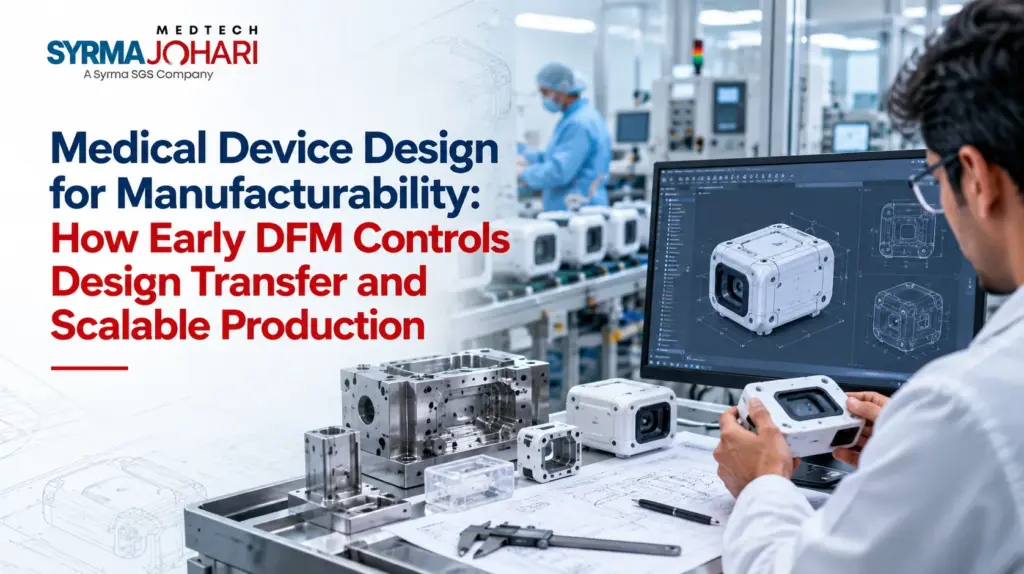
Design decisions get evaluated for manufacturability earlier. When development and manufacturing sit under one partner, choices about materials, tolerances, and assembly methods are pressure-tested against real production constraints from the start. This helps avoid costly redesigns during scale-up.
Faster concept-to-commercialization timelines. When a CDMO handles the entire development process, parallel workstreams such as prototyping, regulatory strategy, process development, tooling can run concurrently instead of sequentially.
Regulatory regimes are getting stricter globally. With EU MDR/IVDR, FDA QMSR, and MDSAP requirements growing more complex, integrated QARA support during development is becoming essential for companies targeting multiple markets.
The Business Impact: CDMO vs CMO
From a business perspective, the differences between the two models can influence development timelines, program costs, manufacturing readiness, scalability, and time to market. Earlyconsideration of manufacturing requirements can help reduce rework during design transfer, while integrating regulatory considerations into development can support greater regulatory readiness as the product progresses.
Having development and manufacturing capabilities connected can make the transition from prototyping to commercial production more coordinated and predictable. However, when a company requires support across multiple stages of the product lifecycle, the broader scope of a CDMO can offer greater integration and potentially greater business value than a manufacturing-only model. For organizations managing multiple development programs, this can also influence how internal engineering, quality, regulatory, and operations teams allocate their resources.
Bringing the Integrated CDMO Model to Life
With a growing number of providers offering different combinations of development, engineering, manufacturing, and regulatory capabilities, selecting the right partner requires a clear understanding of what each organization brings to the table. A broader look at the medical device contract manufacturing and CDMO landscape can help companies understand how different providers compare.
Syrma Johari MedTech brings the integrated CDMO model together across the medical device lifecycle, combining design & engineering, compliance, manufacturing, and product lifecycle management under one partner.
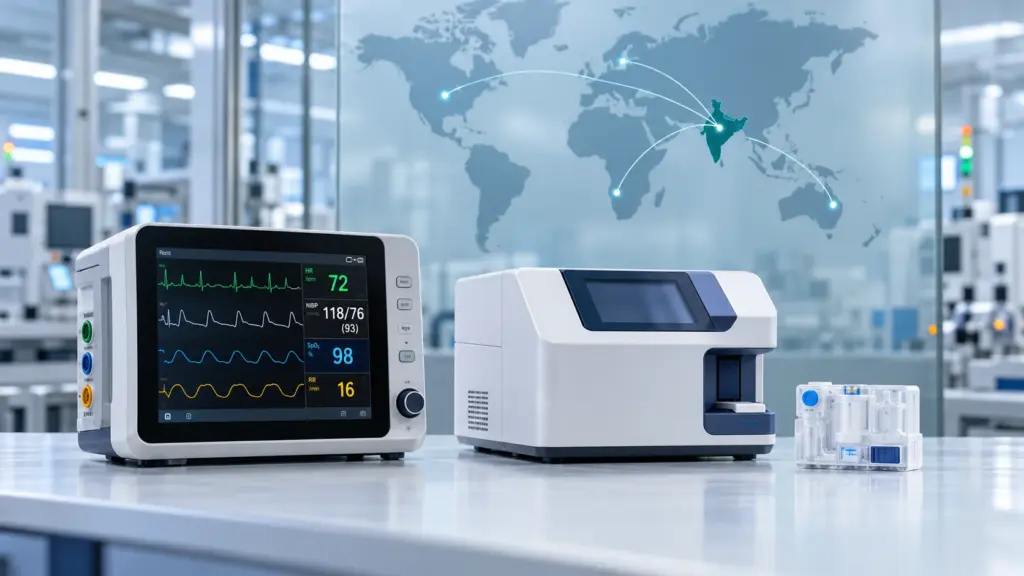
SJML combines cGMP-compliant manufacturing infrastructure, including Class 100,000 cleanroom environments, with engineering, manufacturing, and regulatory capabilities. As the first Indian electronic medical equipment manufacturer to receive MDSAP certification, the company supports global medical device programs through 16 manufacturing facilities and four design centers across India, Europe, and the U.S. Its 34 high-speed SMT lines provide capacity for more than 5 million PCB units annually, while its regulatory affairs expertise spans submissions across 80+ countries and 20+ 510(k) platform submissions.
Syrma Johari MedTech exclusively serves the MedTech industry, supporting engagements from Alpha/Beta prototype through commercial-scale production under one accountable partner.
Conclusion
The choice between a CMO and a CDMO ultimately depends on the requirements, development stage, and objectives of each medical device program. As medical device programs become more complex, integrating capabilities can help companies address challenges earlier, reduce unnecessary coordination, strengthen manufacturing and regulatory readiness, and create a smoother path from development to commercialization.
Beyond the immediate scope of manufacturing, the right outsourcing partner can influence how effectively a product moves from concept through development, design transfer, scale-up, and commercial production. A CDMO’s broader involvement can offer greater value when companies need support across multiple stages of the product lifecycle.
For medical device companies seeking greater continuity from development through commercial manufacturing, explore Syrma Johari MedTech’s CDMO model.