Introduction: The New Language of Device Development
Medical device engineering has always demanded precision. In 2026, however, precision alone is no longer enough. As devices integrate embedded electronics, real-time sensors, wireless connectivity, and AI-driven firmware, development complexity has grown far beyond what traditional prototyping cycles were built to manage.
Enter the digital twin, a technology once synonymous with aerospace and automotive R&D that is now rapidly reshaping how medical devices are conceived, validated, and managed across their entire lifecycle.
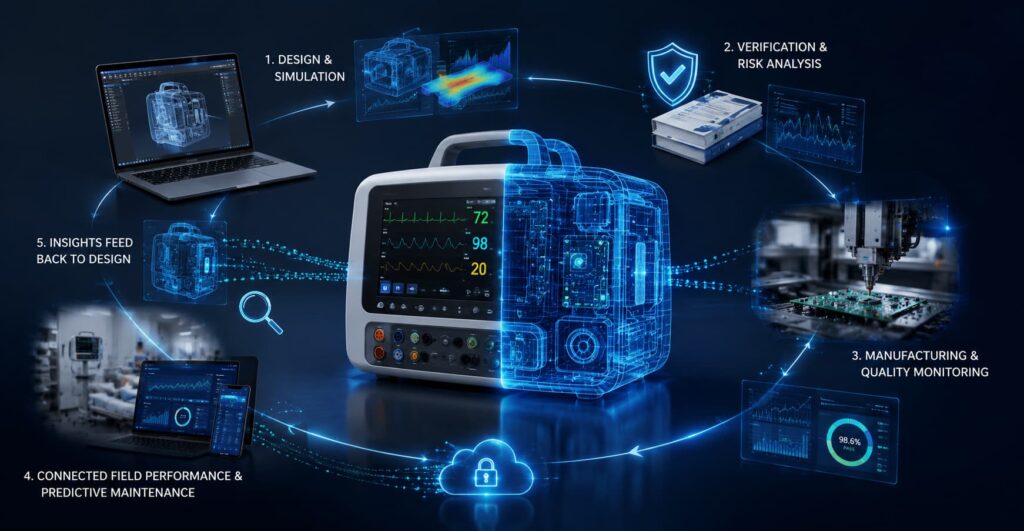
A digital twin is not simply a 3D model or a CAD file. It is a continuously updated, physics-based virtual replica of a physical device or system, informed by real-time sensor data, engineering parameters, and AI-driven simulation. For MedTech manufacturers, this distinction matters: a digital twin does not just show what a device looks like; it mirrors what a device does, how it behaves under stress, and how it is likely to fail before that failure ever occurs in the real world.
At Syrma Johari MedTech, where we engineer, manufacture, and validate medical devices across modalities, from bioelectrical stimulation to patient monitoring and optical imaging, digital twin technology is a natural extension of our commitment to design-for-reliability and lifecycle-led engineering.
What Exactly Is a Medical Device Digital Twin?
The term “digital twin” has accumulated considerable marketing noise. Used loosely, it can describe anything from a product simulation model to a real-time IoT dashboard. In a rigorous engineering context, a digital twin is defined by three core characteristics:
- Fidelity — The virtual model accurately replicates the physical device’s mechanical, electrical, thermal, or physiological behavior, grounded in validated engineering models.
- Continuity — The twin is updated continuously with real-world operational data, evolving alongside the physical device rather than representing a static design snapshot.
- Actionability — The twin drives decision-making, whether that means catching a design defect before tooling, predicting a component failure before it affects a patient, or accelerating a regulatory submission with simulation-backed validation evidence.
In healthcare, digital twins draw on several converging technologies:
- Industrial and medical IoT (Internet of Medical Things, or IoMT)
- AI/ML-driven predictive modeling
- Cloud computing and high-performance simulation
- Real-time sensor data streams from deployed devices
- Physics-based, multi-domain modeling (structural, thermal, electromagnetic)
Market Context: Why Now?
Adoption of digital twin technology in healthcare has accelerated sharply. According to Precedence Research (2025), the global healthcare digital twin market was valued at approximately USD 1.14 billion in 2025 and is projected to exceed USD 9 billion by 2034, growing at a compound annual growth rate (CAGR) of nearly 26%. A separate analysis from Towards Healthcare (2025) forecasts even steeper growth, a CAGR exceeding 42%, with the market reaching USD 77 billion by 2034, driven by rising chronic disease burden and demand for personalized therapies.
Within the narrower segment of digital twin-enabled medical device platforms, Data Bridge Market Research (2026) estimates a CAGR of 23.1% through 2033. The product digital twin segment covering device design optimization, performance simulation, and lifecycle management held the largest market share at 44.3% in 2025.
Asia-Pacific, including India, is expected to be the fastest-growing regional market. This is significant for India-headquartered MedTech manufacturers: the competitive window to embed digital twin capability into core R&D and manufacturing workflows is open now, not five years from now.
Key Insight: The medical device design and testing segment is forecast to grow at the fastest CAGR within the digital twin healthcare market directly relevant to contract design and manufacturing organizations like Syrma Johari MedTech.
Where Digital Twins Are Making a Real Difference in MedTech
Accelerating Device Design and Reducing Prototype Iterations
One of the most immediate benefits of digital twins in medical device R&D is the ability to compress design cycles. Engineering teams can test hundreds of design variants, different material specifications, PCBA layouts, enclosure geometries, and seal-integrity configurations virtually, before committing to physical prototyping.
For a company managing Design for Manufacturing (DFM) workflows across complex multi-layer PCBA assemblies and electromechanical integration, this has both economic and operational impact. Physical prototyping is expensive, time-consuming, and sequential. Virtual iteration is fast, parallel, and reversible.
Leading platforms such as Siemens’ Xcelerator and Dassault Systèmes’ 3DEXPERIENCE used by medical OEMs globally offer physics-based simulation environments where device subsystems (power management, thermal behavior, EMI performance, and structural integrity) can be co-simulated as a unified digital twin.
Predictive Reliability and Failure Mode Analysis
Traditional Failure Mode and Effects Analysis (FMEA) relies on engineering judgment and historical data. Digital twin-based reliability analysis adds a dynamic, predictive layer: the twin models how specific components will age under real-world operating conditions (thermal cycling, vibration profiles, humidity exposure) and predicts when failures are likely to occur.
For medical devices, where the consequence of failure is measured not in downtime but in patient safety, this capability has significant implications for design validation, quality assurance, and post-market surveillance strategy.
Supporting Regulatory Submissions with Simulation-Backed Evidence
The regulatory landscape for digital twin use in medical device development is evolving favorably. In January 2025, the U.S. FDA issued draft guidance explicitly supporting the use of digital twin simulations in regulatory submissions, recognizing virtual testing as a valid method for assessing device safety and effectiveness.
This followed a USD 6 million multi-agency research investment by the NSF, NIH, and FDA in October 2024 to advance digital twin applications in healthcare and biomedical research. The European Medicines Agency (EMA) has similarly issued favorable qualification opinions for digital twin applications in clinical trial design. Together, these regulatory signals suggest that simulation-backed validation is moving from an experimental methodology toward an accepted evidentiary standard.
For MedTech manufacturers navigating 510(k), CE Mark, or CDSCO submissions, incorporating digital twin simulation data into technical files and design dossiers represents a meaningful opportunity to strengthen submissions and potentially reduce the burden of bench or clinical testing.
Virtual Clinical Trials and Patient-Specific Modeling
One of the most ambitious frontiers in digital twin application is the modeling of patient physiology alongside device performance. Researchers at institutions including Johns Hopkins University’s Trayanova Lab and Stanford University’s Center for Biomedical Informatics are developing patient-specific digital twins for conditions such as cardiovascular disease, diabetes, and oncology—virtual models that simulate how an individual patient will respond to a device or therapy before treatment begins.
At the clinical trial level, AI company Unlearn partnered with Johnson & Johnson to demonstrate that digital twins can reduce control arm sizes by up to 33% in Phase 3 trials, a potentially transformative reduction in cost, duration, and patient burden. Phesi has reported comparable results in trials for chronic graft-versus-host disease.
For device manufacturers, virtual patient models can de-risk device-patient interface design decisions and support use-case validation across diverse patient populations earlier in the development cycle.
Post-Market Surveillance and Predictive Maintenance
Once a device is deployed in the field, the digital twin shifts from a design tool to an operational intelligence asset. By continuously ingesting real-world performance data from connected devices, manufacturers can monitor device health at scale, detect anomalies that signal an impending failure, and trigger proactive maintenance or replacement before an adverse event occurs.
GE Healthcare demonstrated this model at the hospital-systems level through its Command Center platform, used during the COVID-19 pandemic, to track real-time bed and ventilator capacity across entire state health systems. Applied at the individual device level, the same principle enables a new generation of post-market surveillance capabilities aligned with evolving regulatory expectations under MDSAP and ISO 13485:2016 quality management frameworks.
How Industry Leaders Are Already Using Digital Twins
| Company | Application | Impact |
| Siemens Healthineers | AI-enhanced digital twins for cardiovascular care (partnership with Mayo Clinic, Sept 2025) | Simulates patient-specific cardiac responses and predicts heart complications using live health records |
| GE Healthcare | Command Center hospital operations digital twin for real-time bed/ventilator tracking | Enabled state-wide critical resource management during COVID-19 and reduced siloed decision-making |
| Nvidia + Mayo Clinic | Human digital twins for next-generation digital pathology and precision medicine (Jan 2025) | Advancing precision medicine and physical AI for individualized diagnostic workflows |
| Unlearn AI + J&J | AI digital twins for Alzheimer’s Phase 3 clinical trials, replacing placebo control arms | Up to 33% reduction in control arm size, cutting trial cost, duration, and patient burden |
Challenges the Industry Must Still Solve
Enthusiasm for digital twins should be tempered by a clear-eyed assessment of where the technology currently faces real constraints.
Data quality and integration. A digital twin is only as accurate as the data feeding it. In healthcare, data fragmentation across device firmware, hospital information systems, and post-market surveillance databases remains a persistent challenge. Building the data pipelines needed to sustain a high-fidelity twin requires upfront investment in both architecture and governance.
Uneven regulatory maturity. While the FDA’s January 2025 draft guidance is a positive signal, full regulatory acceptance of digital twin-based evidence, particularly for clinical trial design and pivotal submissions is still evolving. MedTech teams should engage regulatory affairs specialists early to understand how simulation evidence can complement, rather than replace, established validation frameworks.
Cybersecurity and data privacy. Digital twins that incorporate patient-derived physiological data are subject to stringent data protection obligations under HIPAA, GDPR, and India’s Digital Personal Data Protection Act (DPDPA). Manufacturers must treat cybersecurity as a design-time constraint rather than a post-development add-on, aligned with the FDA’s 2025 AI/ML transparency requirements and ISO 27001 information security frameworks.
Computational cost at scale. High-fidelity, multi-physics simulation is computationally intensive. Cloud-based HPC platforms are making this more accessible, but the cost of running large-scale digital twin environments across device fleets remains a real consideration for smaller and mid-sized manufacturers.
What This Means for MedTech Contract Design & Manufacturing
For organizations like Syrma Johari MedTech operating at the intersection of electronics engineering, medical device design, PCBA manufacturing, and regulatory compliance, digital twin technology applies directly across multiple service areas:
- Design & Engineering – Virtual commissioning of PCBA layouts, thermal management validation, and EMI simulation as standard steps within DFM-driven development cycles
- Contract Manufacturing – Process digital twins for cleanroom manufacturing workflows, predictive quality management, and yield optimization across production lines
- QARA Services – Simulation-backed design verification data as supplementary evidence in regulatory submissions aligned with ISO 13485:2016, MDSAP, and FDA QMSR (effective February 2026)
- Post-Market Lifecycle Management – IoMT-integrated device monitoring frameworks that enable proactive post-market surveillance for connected devices
As India’s MedTech manufacturing ecosystem matures—supported by the government’s Production Linked Incentive (PLI) scheme and growing domestic device development, manufacturers that embed digital twin capabilities into their engineering and quality management workflows will be well positioned to serve global OEM partners demanding faster development cycles, stronger regulatory packages, and more reliable devices.
Conclusion: From Simulation to Standard Practice
The shift of digital twin technology from an advanced research concept to a practical MedTech engineering tool is well underway. Regulatory bodies are signaling acceptance. Major industry players have moved from pilot programs to production deployment. Market investment is accelerating across every relevant application segment.
What makes digital twins genuinely transformative isn’t any single application; it’s the shift in perspective they enable: from reactive engineering (build, test, fix) to predictive engineering, where failure is anticipated and prevented, design decisions are validated virtually before they are committed physically, and devices are monitored and improved continuously throughout their deployed life.
For MedTech companies serious about building the next generation of intelligent, connected, and reliably safe medical devices, the question is no longer whether to engage with digital twin technology, but how quickly and how deeply to integrate it into product development and lifecycle management architecture.
At Syrma Johari MedTech, we are actively building these capabilities as part of our commitment to end-to-end engineering excellence from concept through commercialization for our partners and the patients they serve.
References
- Precedence Research (2025). Healthcare Digital Twins Market Size, 2025–2034. View source
- Towards Healthcare (2025). Healthcare Digital Twin Market Skyrockets 42.2% CAGR by 2034. View source
- Data Bridge Market Research (2026). Digital Twin–Enabled Medical Device Platforms Market Size, Trends, Growth Report 2033. View source
- DelveInsight (2025). Digital Twin Applications and Challenges in the Healthcare Domain. Includes coverage of FDA Jan 2025 draft guidance and Siemens Healthineers–Mayo Clinic partnership. View source
- Applied Clinical Trials (2024). A New Regulatory Road in Clinical Trials: Digital Twins. View source
- Global Forum: DIA (2024). Virtual Patients, Real Results: How Digital Twins Are Reshaping Drug Development. View source
- PMC / National Library of Medicine (2024). Digital Twins for Health: A Scoping Review. GE Healthcare Command Center coverage. View source
- U.S. NSF, NIH, FDA (October 2024). Over $6 million awarded across 7 projects to promote digital twins in healthcare and biomedical research.
- Nvidia Press Release (January 2025). Nvidia and Mayo Clinic Partner to Develop Next-Generation Digital Pathology Tools Using Human Digital Twins.
- Research and Markets (2025). Digital Twins in Healthcare Market Size & Forecast to 2030. View source