Key Takeaways
- The FDA issued a revised General Wellness: Policy for Low Risk Devices guidance on January 6, 2026, superseding the 2019 version. The revision opens a path for non-invasive sensors that estimate physiologic parameters, including continuously worn products.
- What a product monitors, rather than whether it monitors, determines its classification.
- Alerting is the hardest constraint for patient-monitoring products because the function that makes a monitor useful is also the function that makes it a device.
Why Monitoring is a Regulatory Term, not a Product Category
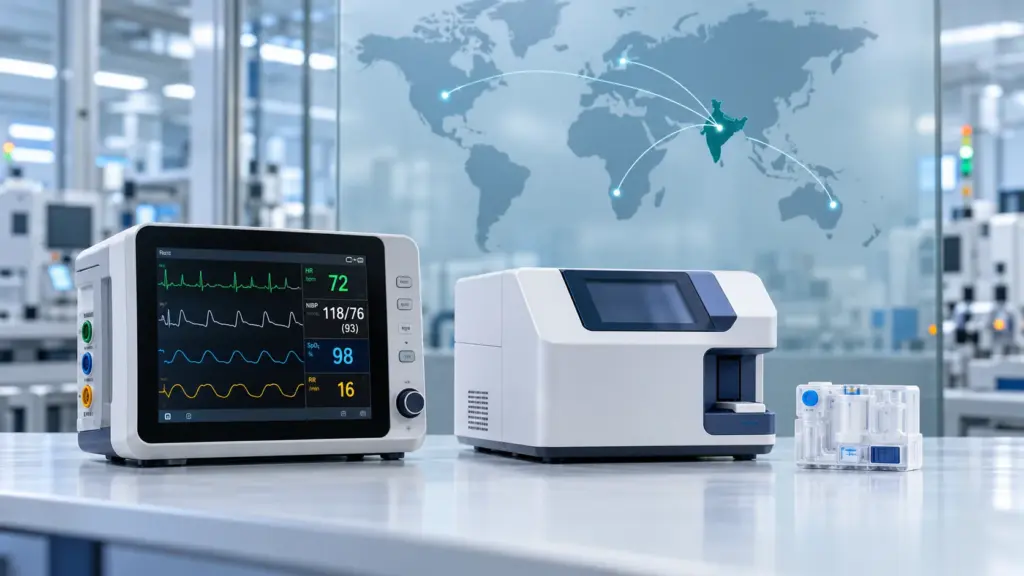
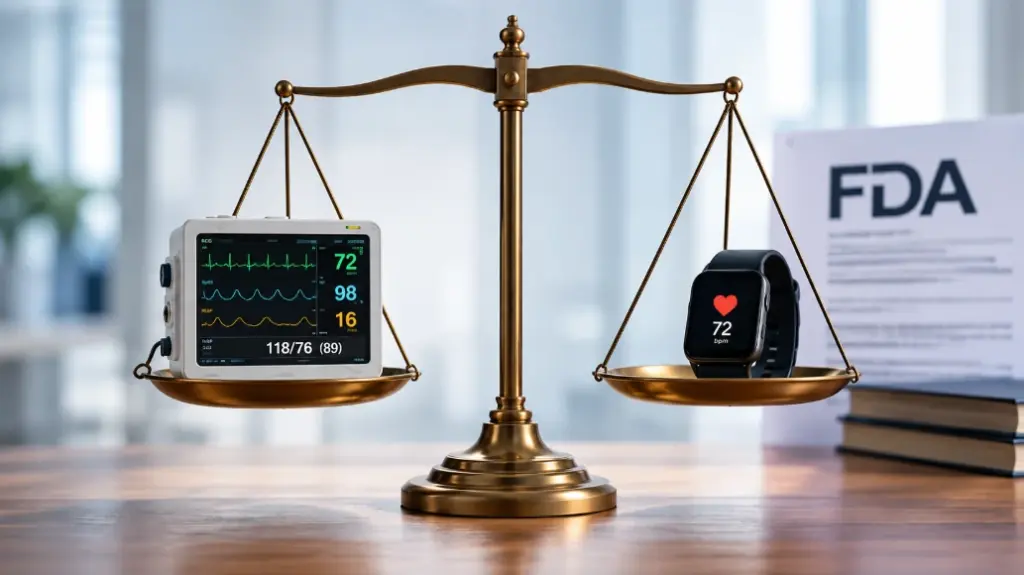
To the companies that build them, patient monitoring devices are a product category. To FDA, monitoring is closer to a statement of intended use.
The revised general wellness guidance lists monitoring alongside screening, diagnosis, alerting, and disease management among the clinical purposes that place a product outside the policy. It appears again among the disqualifying features, which include intended use statements explicitly targeting monitoring of a disease or condition.
The verb alone does not settle it. One of FDA’s own accepted examples is a portable product intended to monitor pulse rate and oxygen saturation during exercise and hiking. That product monitors continuously and is not treated as a device.
What separates the two is the object. Not whether a product monitors, but what it monitors and for what purpose. For any company building wearable patient monitoring products, that distinction determines whether the program carries a quality management system, design controls, premarket submission, and medical device reporting, or none of them.
What the January 2026 General Wellness Guidance Changed
The Center for Devices and Radiological Health issued a revised version of General Wellness: Policy for Low Risk Devices, superseding the version issued in September 2019.
Under the policy, CDRH does not intend to examine low-risk general wellness products to determine whether they are devices, or whether they meet premarket and post-market requirements such as registration and listing, labeling, good manufacturing practice under 21 CFR Part 820, and medical device reporting. Part 820 became the Quality Management System Regulation on 2nd February 2026.
Two factors qualify a product: it must be intended for general wellness use only, and it must present a low risk to users and others.
The material change is a new section on non-invasive sensing. FDA may consider products that use non-invasive sensing, such as optical sensing, to estimate, infer, or output physiologic parameters to be general wellness products when those outputs are intended solely for wellness purposes. The parameters named are blood pressure, oxygen saturation, blood glucose, and heart rate variability.
That list matters to this sector, because those are precisely the parameters patient monitoring products measure.
What a Product Monitors, and for What Purpose
The guidance illustrates the accepted side with three products. A portable monitor of pulse rate and oxygen saturation during exercise and hiking. A wrist-worn wearable measuring sleep by accelerometer and both pulse rate and blood pressure by photoplethysmogram, treated as a wellness product provided the blood pressure values are validated. A non-invasive product for elite athletes tracking electrolyte balance, lactate, and hemoglobin, labeled for exercise only and disclaimed for diagnosis.
The other side is named just as specifically. Products are not general wellness products when intended to measure, estimate, or report physiologic values for medical or clinical purposes, including screening, diagnosis, monitoring, alerting, or disease management. The examples given are blood pressure monitors and sphygmomanometers, fingerstick glucose meters and continuous glucose monitoring systems, electrocardiogram recording and analysis devices, and any product whose outputs inform treatment decisions such as medication dosing.
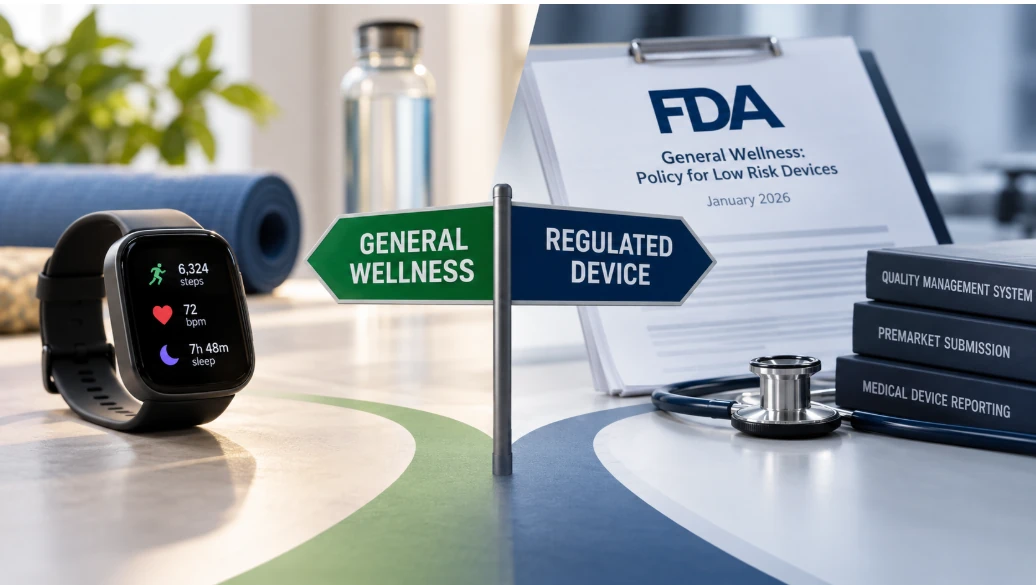
Set those lists side by side, and the pattern is clear. The same parameter appears on both. A photoplethysmogram reporting pulse rate for recovery insight sits on the wellness side. The same sensor, presented as cardiac monitoring, does not.
Why Alerting is the Hardest Constraint for Monitoring Products
This is where the guidance bites hardest on patient monitoring specifically.
A monitor that observes and says nothing has limited value. The clinical and commercial point of continuous monitoring is that it tells someone when something has changed. Yet among the disqualifying features are alerts, alarms, or prompts that recommend or require specific clinical action or medical management.
There is one allowance. A product may inform a user that evaluation by a healthcare professional could be helpful when outputs fall outside ranges appropriate for wellness use. Four conditions are attached. The notification must not name a specific disease or medical condition. It must not characterize the output as abnormal, pathological, or diagnostic. It must not include clinical thresholds, diagnoses, or treatment recommendations. And it must not provide ongoing alerts or monitoring intended to manage a disease or condition.
The last condition is the binding one. A single generic suggestion to consult a clinician is permitted. A standing alert regime running against thresholds, which is what continuous monitoring usually means in practice, is not.
For product teams this is a design decision, not a labeling one. Notification architecture must be settled alongside classification, because a threshold alarm added late can reclassify a product that was compliant the day before.
Why Values must be Validated but not Called Clinically Accurate
Two requirements pull against each other, with direct engineering and commercial consequences.
A product must not display values mimicking those used clinically unless validated to reflect them, through manufacturer testing or peer-reviewed literature. The wrist-worn example qualifies only because its blood pressure values are validated. Validation is not optional for a wellness product that outputs a clinically recognizable number.
At the same time, claims of clinical equivalence, clinical accuracy, medical or clinical grade, or substitution for an authorized device are disqualifying on their own.
A manufacturer must therefore validate against a clinical reference and must not market on it. That evidence belongs to the design history file and the classification rationale, not on the packaging or in the app store listing.
How Sensor Placement and Modality Affect the Invasiveness Test
Patient monitoring is moving into ring, patch, and eyewear form factors, which makes the risk test worth understanding precisely. It asks three questions. Is the product invasive, meaning it penetrates or pierces skin or mucous membranes? Is it implanted? Does it involve technology that could pose a safety risk without specific regulatory controls, such as lasers or radiation? A yes to anyone who placed the product outside the policy.
The guidance includes a wearable estimating blood glucose through minimally invasive microneedle technology, contraindicated for people with diabetes or pre-diabetes and marketed to understand insulin response to food. FDA accepts the wellness claim, and still concludes the product is not low risk, because the technology penetrates the stratum corneum.
Optical sensing keeps a ring, a wrist band, a patch, or a temple mounted sensor on the non-invasive side of the test. A sensor that breaks the skin fails wherever it sits on the body. Placement is usually chosen for signal quality, comfort, and available volume, but the sensing modality underneath carries the regulatory consequence, identically in every form factor.
What this Means for Patient Monitoring Device Programs
Settle what the product monitors for before fixing the architecture, since that decides whether design controls apply from the first prototype or from a later remediation effort. Treat alerting and notification design as a regulatory artifact, reviewed on the same cadence as hardware and firmware, and apply that change control to labeling, interface copy, and marketing communications as well. A compliant wearable can be reclassified by a screen shipped without regulatory review.
Teams expecting to move a monitoring product from wellness positioning to cleared status later should build to a stricter standard from the outset. Retrofitting design controls, traceability, and supplier quality onto a consumer program cost far more than applying them from the start.
Looking Ahead
The guidance is nonbinding and represents FDA’s current thinking rather than an enforceable requirement. How the agency applies, it will become clearer through enforcement, and manufacturers would be unwise to design a monitoring product that depends on the most generous available reading of it.
Syrma Johari MedTech develops and manufactures patient monitoring products across this line, from regulated hospital and clinical monitoring systems to wearable and home monitoring devices. The company holds ISO 13485:2016 certification, Medical Device Single Audit Program (MDSAP) compliance, and EcoVadis certification, and has taken monitoring programs through the US FDA, CE, and CDSCO pathways. Syrma Johari MedTech is glad to discuss where a given product is likely to land before the architecture is fixed.
References
- US Food and Drug Administration. General Wellness: Policy for Low Risk Devices. Guidance for Industry and Food and Drug Administration Staff, issued 6 January 2026. Docket FDA-2014-N-1039. Link
- US Food and Drug Administration. General Wellness: Policy for Low Risk Devices, full guidance document. Link
- US Food and Drug Administration. Town Hall: General Wellness: Policy for Low Risk Devices, Final Guidance, 11 February 2026. Link