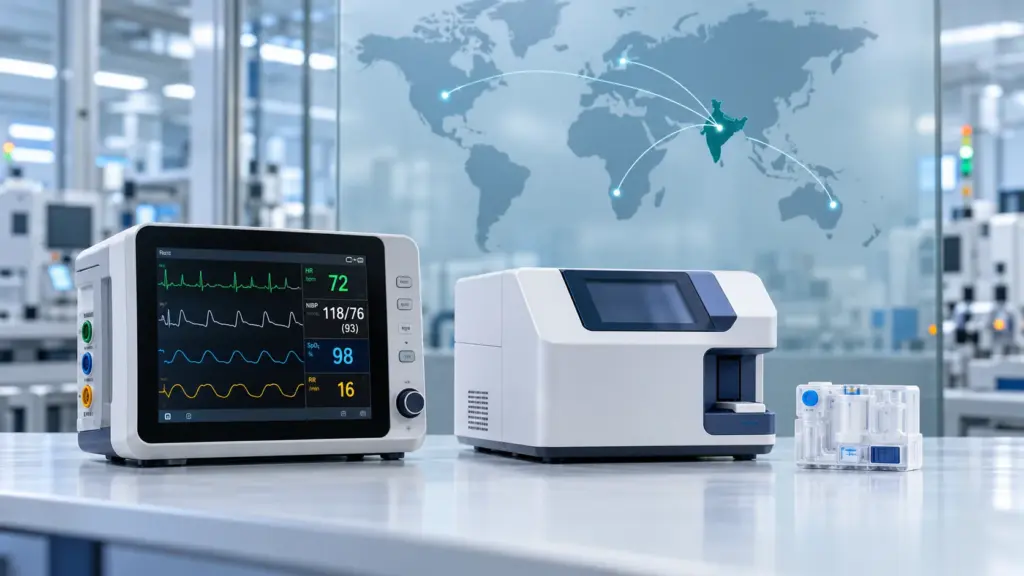
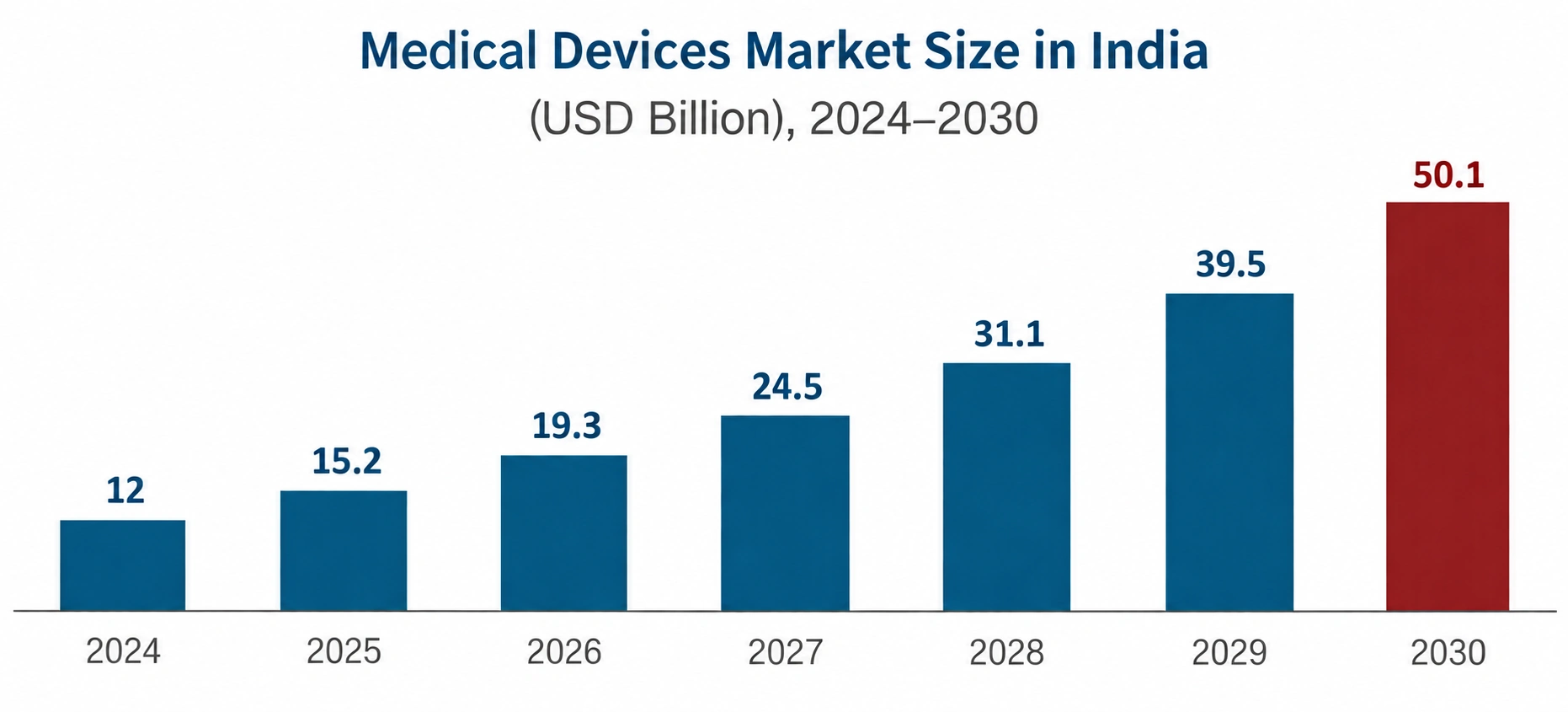
India’s medical device industry is gradually entering a new phase of growth. The consistent rise in manufacturing capacities has contributed to the country’s ability to serve markets beyond its domestic borders. The opportunities have shifted from producing medical devices for domestic companies to building products and manufacturing systems that can suffice global MedTech markets. India’s medical device market is projected to grow from USD 15.2 billion in 2025 to USD 50.1 billion by 2030, reflecting a rapid expansion of the domestic MedTech ecosystem.
India’s medical-device exports reached USD 4.1 billion in FY25, increasing at a 10% CAGR between FY23 and FY25. The government has set an ambitious target of increasing India’s share of the global medical-device market from 1.65% to 10–12% in the coming years. The US and Germany are already among India’s key export destinations, highlighting the increasingly significant role of Indian manufacturers in international supply chains. Evidently, increasing manufacturing capacities has majorly contributed to India’s rising exports.
However, expanding exports requires more than simply increasing production volumes. Global MedTech markets bring stringent expectations around quality, regulatory compliance, process control, traceability, and supply reliability. For Indian MedTech manufacturers, the next opportunity is therefore to move from being a cost-competitive manufacturing destination to becoming an export-ready MedTech manufacturing partner.
India’s Export Opportunity Is Already Taking Shape
In recent years, India’s export capabilities have considerably increased. The country is positioned to evolve into a global hub for high-quality, export-led medical-device manufacturing. Government initiatives such as the National Medical Devices Policy, PLI Scheme, medical-device parks, and export-promotion measures are further supporting this transition.
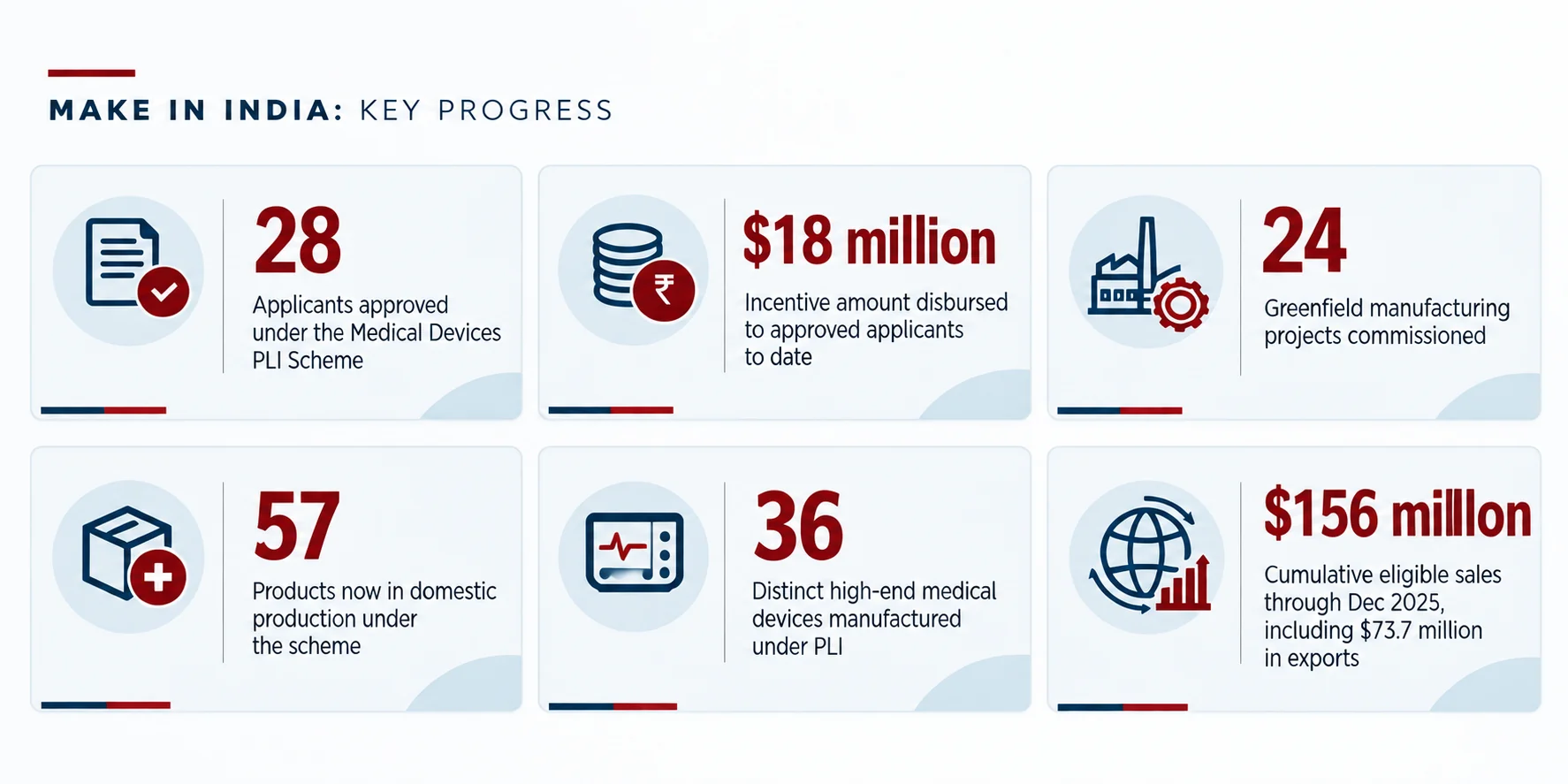
India’s manufacturing ecosystem supports precision engineering, advanced tooling, and complex MedTech production, with global MedTech companies already manufacturing sophisticated medical devices in the country for both domestic and international markets. Most manufacturers are following approaches that integrate validated processes, measurable specifications, and robust quality systems, ensuring that manufacturing excellence is driven by process capability and quality discipline rather than geography.
For MedTech manufacturers, however, the challenge lies in sustaining their position rather than entering this market. To do so, manufacturers must be able to deliver consistent quality, meet market-specific regulatory requirements, maintain production controls, and support customers across the product lifecycle.
Global MedTech Markets Demand More than Just Cost-effectiveness
Cost competitiveness has been one of India’s manufacturing advantages. However, for global MedTech OEMs, manufacturing decisions involve considerations that extend well beyond unit cost.
A global manufacturing partner must demonstrate control over the processes that determine product quality and consistency. This includes qualified suppliers, controlled manufacturing processes, validated equipment and processes, traceability, documentation, testing, change management, and the ability to maintain product specifications across production volumes.
The requirement becomes particularly important for CDMOs given that quality cannot be established through final inspection alone. The manufacturing process itself must be capable of consistently producing a product that meets defined specifications.
Thus, for Indian manufacturers, the competitive proposition must evolve from manufacturing at competitive costs to manufacturing consistently, compliantly, and at scale.
Quality-driven Lifecycle: A Gateway to Global Markets
For medical device manufacturing, quality should be brought into the picture right from the development and risk management through production, regulatory compliance, and post-market activities.
A quality-driven lifecycle connects product requirements with manufacturing processes, supplier controls, risk management, testing, documentation, and corrective and preventive actions. It also establishes the traceability required understand how a product was manufactured, how deviations were addressed, and how changes were assessed and implemented.
This approach will most significantly affect production at scale. Increasing volumes can introduce greater process variation. Furthermore, changes in components, suppliers, equipment, or manufacturing methods may create new quality risks. A lifecycle-based approach helps ensure that quality is maintained as the product, process, and market requirements evolve.
For manufacturers, the objective is therefore not only to maintain an appropriate quality management system (QMS), but to embed quality controls throughout the product lifecycle. This includes process validation, supplier quality management, production controls, traceability, change management, CAPA, and ongoing monitoring of product and process performance.
Thus, bringing in quality considerations at the initial stages could help establish the foundation for regulatory confidence, supply reliability, and ultimately, a greater access to global MedTech markets.
Why Regulatory Readiness Determines Market Access
Since regulatory and compliance considerations vary by regions, it is important to consider regulatory readiness at the start. These requirements can span device classification, risk management, technical documentation, verification and validation, quality systems, labelling, submissions, audits, and post-market obligations. The specific requirements also vary across markets, making regulatory knowledge an important component of export readiness.
Manufacturers supplying international OEMs must understand the regulatory expectations that influence both product development and manufacturing operations. Documentation, traceability, change control, process validation, and quality records could all support regulatory compliance. As such, QARA plays an increasingly important role in global market access, given its significance in navigating global regulations.
From “Make in India” to “Make in India for the World”
The transition from domestic manufacturing to global supply requires an ecosystem that supports the entire product lifecycle, and evidently, government initiatives in India have helped establish the necessary foundations.
For MedTech companies, this can mean connecting engineering and manufacturing with quality systems, regulatory requirements, supply-chain management, and lifecycle support. Isolated operations could introduce risks such as regulatory gaps, process inconsistencies, and subsequent delays. An integrated model has thus become increasingly relevant to India’s ambition of becoming a global MedTech manufacturing hub.
In recent years, increasing investments by global medical-device players have helped the country evolve as a manufacturing and innovation hub. For domestic manufacturers, the opportunity, therefore, is to move from “Made in India” to “Made in India for the world.” In terms of competitive advantage, this means looking beyond cost-efficient production toward globally compliant, quality-driven, and scalable manufacturing.
The Real Test of India’s MedTech Ambition
India’s growing medical-device exports demonstrate the country’s potential to become a significant global manufacturing base. As this opportunity expands, the focus could shift from increasing production capacity to building manufacturing capabilities that can consistently meet the expectations of international MedTech markets. With the “Make in India for the World” initiative, SJML leverages its domestic manufacturing capabilities to support global MedTech companies.
The Make in India initiative is increasingly supported by SJML capabilities that extend across the MedTech value chain. In precision-critical applications such as endoscopy, for example, capabilities in product industrialisation, DFM, precision tooling, material selection, process development, inspection, and production scale-up support the transition from product requirements to repeatable manufacturing. These capabilities demonstrate how India’s manufacturing ecosystem can support not only component production, but also the localization and industrialisation of specialised medical-device products for global markets. Similar capabilities across IVD, respiratory care, medical plastics, electronics, and other MedTech segments strengthen India’s potential as an export-oriented manufacturing base.
The opportunity for India is therefore not limited to becoming a larger manufacturing destination. For global OEMs, this could be an opportunity to look beyond India as a cost-effective manufacturing base and consider it as a strategic destination for global medical-device production. The ability to combine manufacturing scale with global quality and compliance will be central to realizing the country’s export potential. Ultimately, “Make in India for the World” represents an opportunity to position India as a strong manufacturing base for the global MedTech industry.