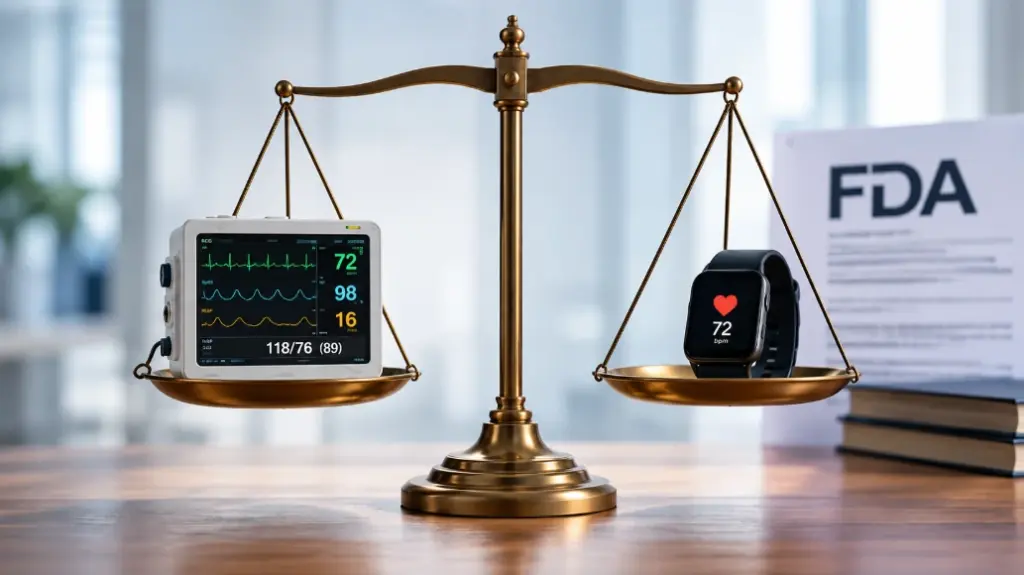
Traditional medical device clearances treat software as a static milestone. Previously, every major software upgrade required a brand-new review cycle. This introduced substantial commercial and administrative delays to modern SaMD lifecycle practices, where rapid iteration is critical to time-to-market.
The Challenge Facing Medical Device OEMs
For manufacturers developing AI-enabled medical devices, this regulatory friction creates a difficult dilemma. Machine learning models thrive on continuous updates with fresh clinical data. Freezing an algorithm limits its clinical utility over time. Yet, submitting a new premarket filing for every routine algorithmic improvement grinds commercial momentum to a halt.
To navigate this hurdle, many manufacturers currently adopt defensive compromises:
- Freezing algorithms post-launch: OEMs lock models at initial clearance, leaving clinical performance gains and edge-case improvements on the table.
- Absorbing review delays: Teams submit sequential supplemental filings, incurring repeated regulatory review fees and multi-month delays for minor model iterations.
The ideal solution is a prospective, pre-cleared modification framework. Engineering teams require a compliant pathway to iterate algorithms, supported by comprehensive medical device testing methodologies and verification frameworks that keep software responsive to real-world evidence. When managing medical device software modifications, FDA expectations focus on ensuring that performance floors remain uncompromised.
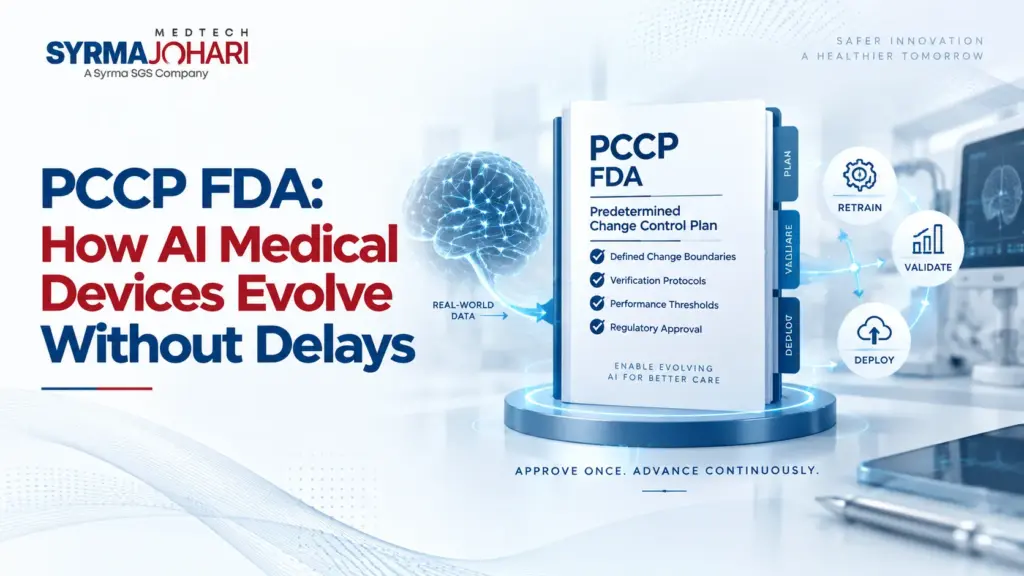
The FDA addressed this challenge through the predetermined change control plan. Implementing a predetermined change control plan for medical devices allows computer-automated and planned iterative changes to an algorithm under a single original 510(k), De Novo, or PMA application. By establishing agreed modification boundaries and verification protocols directly during early SaMD technical file preparation, OEMs can deploy planned upgrades without triggering redundant resubmissions.
At Syrma Johari MedTech, we close this gap with an integrated QARA strategy, helping healthcare pioneers integrate scalable quality management systems with cutting-edge software modifications, partnering with innovators to achieve global medical device clearance with absolute regulatory confidence.
What Is a Predetermined Change Control Plan for AI Medical Devices?
A PCCP for AI-enabled medical devices establishes a clear “fence” around the initially authorized algorithm. Within these predefined boundaries, the manufacturer can make specified changes to the device’s software or hardware without supplementary filings.
Within the framework of a PCCP for AI-enabled medical devices, the manufacturer details:
- What prospective modifications it plans to implement in the future.
- The specific validation and verification protocols it will apply to each type of change.
The regulator formally evaluates the submission during the initial review cycle, focusing on the proposed method of AI change management.
A practical PCCP implementation can be structured around four stages:
PCCP Deployment Workflow
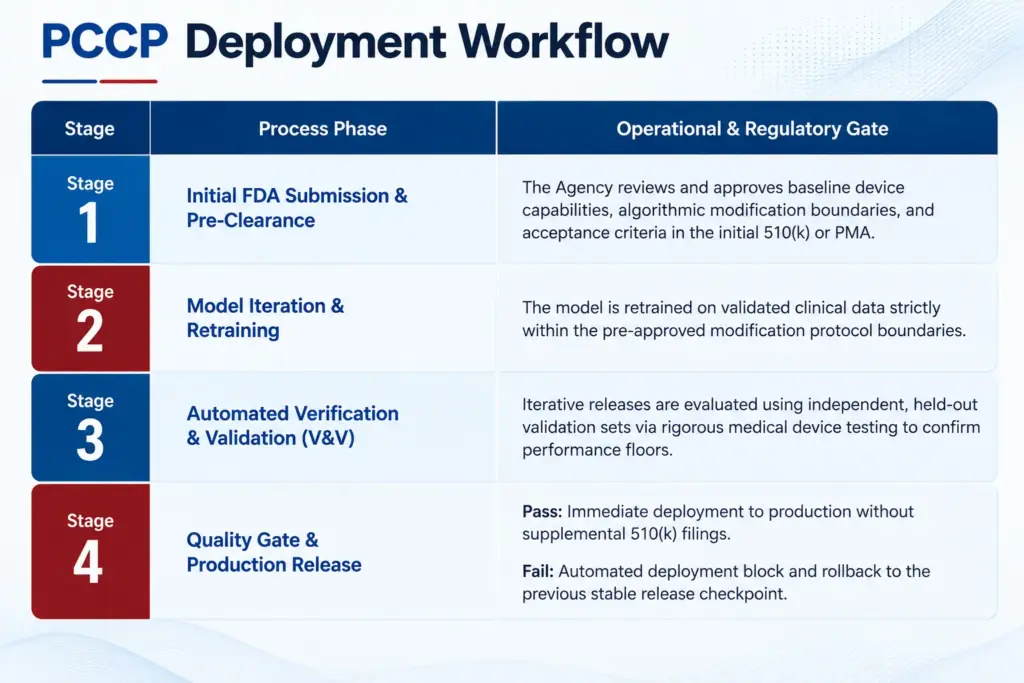
- Review and Authorization: The FDA reviews and approves the initial software and the modification control plan.
- Controlled Retraining: The development team trains the model within the established confines of the change control plan.
- Held-Out Validation: Engineers evaluate successive releases using independent, held-out validation sets via rigorous medical device testing.
- Automated Deployment Gate: Only code that passes all automated tests is released into the production environment. Failed builds are automatically blocked from further processing, with the previous stable version of the code serving as the default checkpoint, minimizing disruption to clinical operations. This setup ensures patient safety by preventing unauthorized modifications to the production code.
Statutory Authorization for PCCPs
The Food and Drug Omnibus Reform Act of 2022 (FDORA) established Section 3308, which amended the FD&C Act by adding Section 515C, permitting prospective clearances of algorithmic modifications to 510(k) or PMA authorized AI medical devices, provided the initial safety profile of the product has been maintained.
Section 515C stipulates that a change control plan must include a specific assurance of performance floors and the required notifications in the event of a failure to meet them.
Section 515C also contains an anti-moat provision, which prevents the manufacturer from using the modified device as a predicate for future devices. As a result, competitors and contract developers who wish to use the authorized algorithm as a reference point in the future will have to rely on the initially cleared baseline code.
Global Landscape and Key PCCP Milestones
The regulatory ecosystem governing predetermined change control plans and algorithm adaptation has accelerated rapidly across North America, Europe, and international harmonization panels:
| Document / Milestone | Issuing Body | Effective Date | Regulatory Scope |
| Guiding Principles for MLMD | U.S. FDA / Health Canada / UK MHRA | October 2023 | Core guiding principles for change-plan architectures |
| Predetermined Change Control Plans for Devices | U.S. FDA | August 2024 | Draft guidance expanding PCCPs to hardware and diagnostics |
| Final AI Software PCCP Guidance | U.S. FDA | December 2024 | The final FDA PCCP guidance governing algorithmic change control |
| Post-Market Lifecycle Guidance | U.S. FDA | Early 2025 | Draft guidance governing post-market monitoring and continuous lifecycle oversight |
| IMDRF N90 Standards | IMDRF | August 2026 | Harmonized international standard for software change control |
Core FDA PCCP Requirements for Technical Modules
Regulatory submissions require three standalone modules within the technical file to satisfy all FDA PCCP requirements:
1. Description of Modifications
This module defines the explicit scope for prospective AI/ML medical device modifications. Vague statements about “improving model performance” typically face regulatory pushback or rejection during review. Instead, teams should request specific, quantifiable modifications to the algorithmic architecture, such as:
- Hyperparameter retraining across multi-center clinical cohorts.
- The addition of new inputs, such as newer imaging sensor configurations or modalities.
- Adjustment of alert thresholds to reduce clinical alarm fatigue while retaining core diagnostic sensitivity.
2. Modification Protocol
The second module provides a comprehensive protocol detailing how data will be managed and models retrained and verified. The protocol embeds software lifecycle controls and rigorous design controls to prevent data drift, overfitting, and demographic disparities by relying on sequestered, unseen clinical datasets for all validation components. In addition, the protocol must establish automatic rollback procedures in the case of deployment anomalies, alongside transparent user notification plans.
3. Impact Assessment
The third module is the formal clinical and regulatory impact assessment. Manufacturers must evaluate the cumulative clinical risk of sequential AI medical device software updates and ensure that the changes do not undermine the safety and effectiveness of the original device before final commercial rollout.
Industry Adoption Trends and Submission Gaps
Industry adoption of PCCPs continues to be selective, despite the availability of regulatory frameworks:
- Current Adoption: A 2026 study published in JAMA Health Forum showed that only 5.4% of 794 authorized devices were able to successfully incorporate an authorized change plan. Although over 1,450 AI medical devices have received clearance, overall adoption hovers around 6%.
- Review Durations: An analysis by Almarie et al. in Biomedicines found that the median duration for the FDA review process was 162 days, highlighting that software architecture and verification documentation contribute significantly to timeline friction.
- Structural Gaps: An evaluation of public reporting of PCCPs highlights technical compliance gaps across published submissions:
- 90.7% successfully disclosed proposed modifications.
- 83.7% adequately detailed verification and validation protocols.
- 74.4% outlined essential user notification plans.
- 72.1% failed to report all core FDA-recommended summary elements.
- 32.6% shared public impact assessments.
Comparing United States and European Regulatory Frameworks
While both jurisdictions support pre-planned modifications, navigating the EU MedTech regulatory framework alongside FDA expectations requires understanding how their regulatory mechanisms differ fundamentally:
| Regulatory Feature | United States (FDA) | European Union (MDR / AI Act) |
| Statutory Authority | FD&C Act Section 515C | Regulation (EU) 2024/1689 (EU AI Act), Articles 3(23) & 43(4) |
| Operational Guidance | Final December 2024 Guidance | MDCG guidance harmonized with IMDRF N90 |
| Modification Review | Pre-cleared envelope bypasses supplemental filings | Dual assessment under MDR “significant change” and AI Act rules |
| Enforcement Status | Actively reviewed and enforced | High-risk AI enforcement takes full effect August 2028 |
90-Day Implementation Roadmap for Medical AI Teams
Successfully implementing an AI medical device PCCP in 90 days operationalizes regulatory guardrails into agile engineering sprints:
Weeks 1 to 4: Technical Scope and Boundary Audits
- Catalog algorithms targeted for modification within the next 24 months.
- Ensure proposed modifications are strictly consistent with the cleared intended use (modifications altering intended use require a separate marketing authorization).
- Establish specific mathematical and functional boundaries for each modification.
- Analyze data accessibility and demographic diversity across targeted patient populations.
- Determine whether the initial submission will be a new marketing application or a supplement.
Weeks 5 to 8: Acceptance Thresholds and Governance
- Set performance floors for sensitivity, specificity, and accuracy for each subpopulation.
- Ensure performance floors represent validated clinical utility at each patient cohort level.
- Segregate and isolate clinical validation datasets to prevent data leakage.
- Establish clinician-facing notification procedures and release-note disclosures detailing model version updates.
- Institutionalize AI medical device governance across cross-functional engineering and clinical teams.
Weeks 9 to 12: Pipeline Orchestration and FDA Readiness
- Orchestrate CI/CD pipelines to record device modifications directly into the Design History File (DHF), ensuring that the audit trail meets FDA QMSR expectations.
- Test and verify that automated rollback procedures function properly under anomaly conditions.
- Schedule an FDA Pre-Submission (Q-Submission) meeting to confirm agency alignment on technical boundaries.
- Align the three technical modules with EU AI Act Article 43(4) technical dossier requirements.
Accelerating Compliance with Syrma Johari MedTech
Operationalizing predetermined change control plans requires synchronized execution across software engineering, quality systems, and regulatory affairs. At Syrma Johari MedTech, we partner with MedTech OEMs and digital health pioneers to design defensible modification protocols, configure compliant verification pipelines, and prepare regulatory dossiers that withstand rigorous global scrutiny—enabling your medical AI to evolve safely without market disruption.
Frequently Asked Questions (FAQ)
What is an FDA PCCP submission?
A PCCP is part of an original device submission (510(k), De Novo, or PMA) that designates software and algorithm modifications intended for post-market deployment. When approved, this allows changes to the device without the need to submit a new premarket filing.
What are the technical module requirements?
The FDA requires three core modules within the marketing submission: the Description of Modifications, the Modification Protocol, and the Impact Assessment. In addition, the submission must detail clinician notification protocols and automated rollback procedures.
Can a modified device be used as a predicate?
No. A device modified under an authorized plan cannot be used as a predicate device in subsequent 510(k) submissions. This anti-moat provision under Section 515C ensures fair competition and prevents unverified algorithmic creep from becoming an industry baseline.
Are PCCPs applicable to continuous learning medical devices?
Yes. PCCPs directly apply to continuous-learning AI medical devices. While early implementations prioritized batch retraining, the framework establishes the precise verification protocols, data isolation rules, and performance floors required for continuous learning models to evolve safely without exceeding predefined clinical guardrails.
Can manufacturers of medical devices add a plan to existing products?
Yes. Manufacturers do not have to wait for a completely new product release. A PCCP can be added to an existing, commercially authorized device by submitting a supplemental marketing application (such as a 510(k) or PMA supplement) to establish the pre-cleared modification envelope.