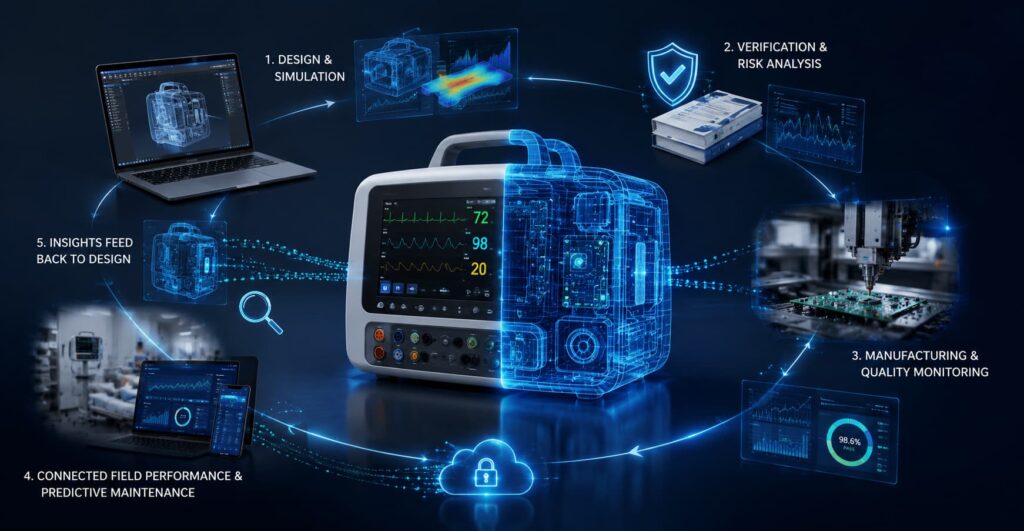
For medical device companies, outsourcing is no longer simply about adding manufacturing capacity. It can play a strategic role in how products are developed, validated, manufactured, scaled, and brought to market. The right partner can bring specialized expertise across engineering, compliance, manufacturing, and commercialization while helping companies manage complexity, maintain quality, and build regulatory readiness from the outset.
This makes partner selection a critical business decision. Beyond cost and production capacity, companies need to consider a partner’s technical capabilities, quality infrastructure, regulatory experience, scalability, and ability to provide continuity across the product lifecycle.
Understanding Medical Device Outsourcing
Medical device outsourcing extends across multiple stages from concept development and engineering to design verification and validation, regulatory strategy, manufacturing transfer, commercial production, supply chain management, and post-market support. The scope of engagement depends on various factors, including the company’s internal capabilities, device complexity, development timelines, and regulatory requirements.
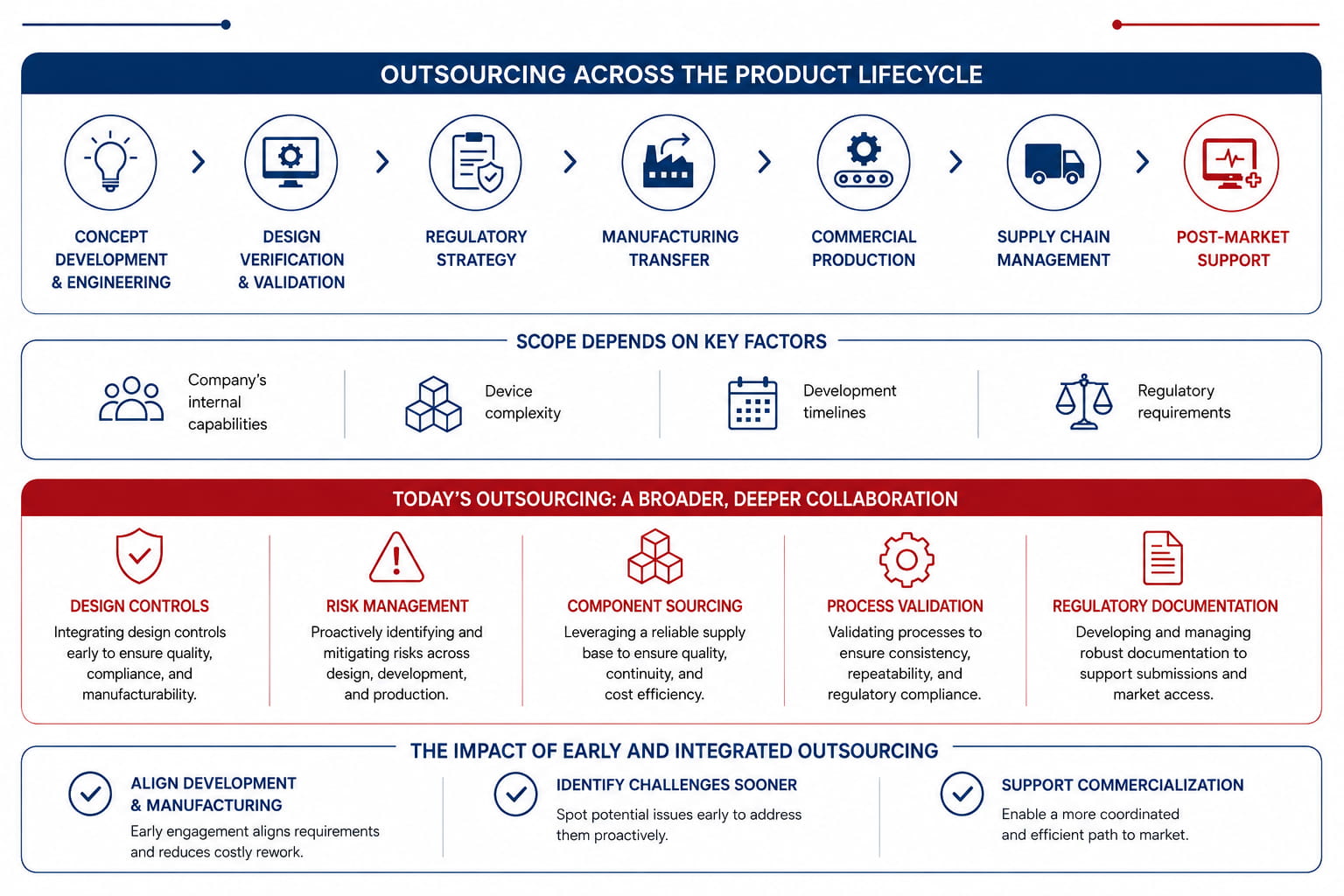
Two of the most significant areas are design and development and manufacturing and production, each presenting distinct considerations for companies evaluating an outsourcing partner. This distinction represents a broader model in comparison with traditional contract manufacturing, which mainly focuses on producing devices in accordance with established specifications. Today, medical device outsourcing can involve deeper collaboration across design controls, risk management, component sourcing, process validation, and regulatory documentation. Engaging these capabilities earlier in the product lifecycle can help align development and manufacturing requirements, identify potential challenges sooner, and support a more coordinated path to commercialization.
Design and Development Outsourcing
Design and development outsourcing covers the front end of the product lifecycle, including concept development, industrial design, mechanical and electronic engineering, firmware and software development, prototyping, human factors engineering, and design verification. This stage establishes major foundational decisions around materials, architecture, user interaction, and testability.
On the outsourcing front, the design and development stage holds great significance, given its direct connection to downstream manufacturing and regulatory requirements. A design developed without adequate input from manufacturing engineers may function technically but prove difficult to assemble consistently, test efficiently, or scale cost-effectively. Similarly, designs that do not incorporate design controls aligned with applicable regulatory and quality requirements such as FDA 21 CFR 820.30 or ISO 13485 may require significant rework as the product progresses toward submission. Engaging an outsourcing partner with both design expertise and manufacturing capability can help align these considerations earlier and reduce potential downstream challenges.
Manufacturing and Production Outsourcing
Manufacturing and production outsourcing remains a core component of medical device outsourcing. It can involve transferring an existing product to a contract manufacturer, piloting a new design through initial production runs, and scaling manufacturing to commercial volumes. Manufacturing support can also extend from initial production runs and assembly through testing, packaging, sterilization, and commercial-scale production.
The effectiveness of manufacturing outsourcing heavily depends on the quality of the production process, including validated processes such as IQ/OQ/PQ, statistical process control, traceability systems, and integration with design-for-manufacturing (DFM) principles. Manufacturing partners supporting the development of regulated medical devices also need appropriate clean-room classified facilities, quality systems, and process controls to maintain consistent production and documentation. Selecting a partner without sufficient experience in regulated medical device production may introduce yield, compliance, or documentation risks that outweigh potential unit-cost savings.
For companies evaluating a manufacturing partner, the focus should therefore extend beyond production capacity to factors such as process maturity, quality systems, regulatory experience, scalability, and the ability to maintain consistent production at commercial volumes.
Integrated CDMO Partnerships
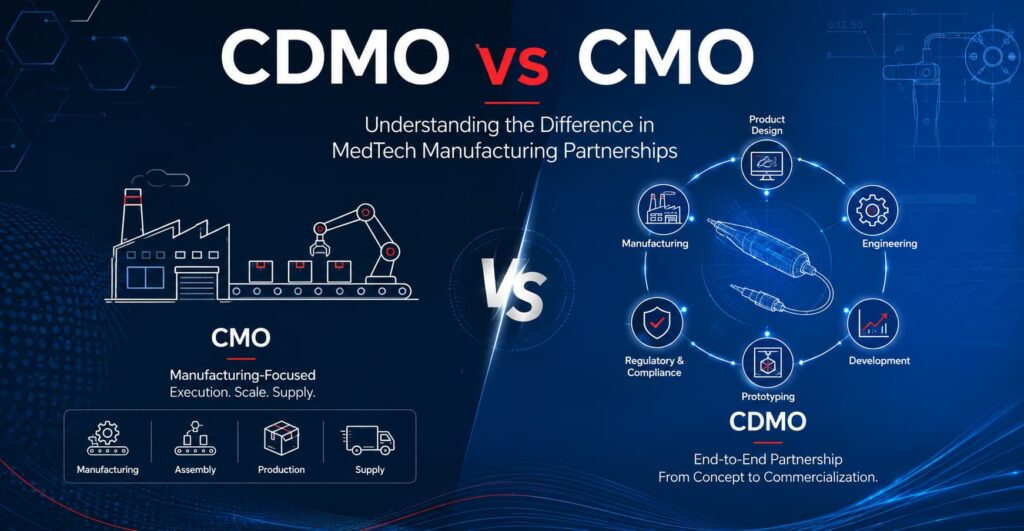
An integrated contract development and manufacturing organization (CDMO) brings together design, engineering, regulatory, manufacturing, and lifecycle services under one organizational framework. Unlike a traditional contract manufacturer that becomes involved once a design is established, or a standalone engineering partner that may transition the program after development, a CDMO can support the product from feasibility and development through commercialization and scale-up.
The significance of this model lies in the connecting capabilities that are closely linked throughout the product lifecycle, which subsequently reduces handoffs. With a CDMO, design decisions can be evaluated against manufacturing requirements. Furthermore, regulatory considerations can be incorporated earlier, and production planning can inform development and scale-up. This can reduce the need to coordinate across multiple specialized partners while creating greater continuity across design, compliance, quality, and manufacturing activities. For complex medical device components and systems where design, compliance, and production are deeply interdependent, this approach can provide greater visibility and accountability across the program.
For companies evaluating an outsourcing partner, the key consideration is therefore not only what services a provider offers, but how effectively those capabilities work together across the product lifecycle. The right model will depend on the complexity of the device, internal capabilities, development stage, regulatory requirements, and manufacturing objectives.
Strategic Outsourcing Applications
Each outsourcing model serves different program needs. The right approach depends on the product’s development stage, internal capabilities, manufacturing requirements, and risks associated with commercialization.
Early-stage Product Development
For startups and early-stage programs, engaging an outsourcing partner during concept and feasibility could help establish a stronger foundation for development. At this stage, the partner contributes in terms of market-requirements analysis, early regulatory strategy (mapping to FDA 510(k), CE marking, or other pathways), proof-of-concept prototyping, and risk assessment aligned with ISO 14971. Other support may also include prototyping early regulatory planning, design risk assessment, and manufacturability considerations, allowing teams to test designs quickly before committing to tooling or production infrastructure.
Early involvement can also help identify component availability, assembly, testing, and material cost challenges even before the design is finalized. Outsourcing allows small and mid-sized medical companies to enter the market without large upfront investments in equipment, facilities, or specialized personnel. This can reduce downstream rework while allowing medical device companies to access specialized expertise and manufacturing infrastructure without making significant upfront investments.
Manufacturing Transfer and Scale-up
Transferring an existing product to a new manufacturing partner requires alignment across auditable design history file (DHF), device master record (DMR), validated process documentation, and clear acceptance criteria for the final product.
The transition from pilot to commercial volumes introduces additional challenges such as tightening process windows, ramping yield, expanding inspection and testing capacity, and ensuring supply chain robustness. An experienced contract manufacturer can support this transition through structured transfer processes, process validation, and production readiness activities. Access to established medical infrastructure and quality systems can help new medical device companies scale production without building new capacity from the ground up.
Lifecycle and Obsolescence Management
The outsourcing relationship does not end when a medical device reaches the market. After-market services such as component obsolescence management, design updates, post-market surveillance, cost optimization through value engineering, field failure analysis, and regulatory file maintenance are critical requirements. Companies must also maintain regulatory compliance throughout the life of medical devices to avoid quality failures, recalls, or market withdrawal.
A partner with proactive component obsolescence management can monitor BOM stability, qualify alternate components, manage last-time buys, and execute design changes with full change-control documentation. Such services differentiate a product that remains commercially viable for a decade from the one that faces supply disruptions within a few years of launch.
With outsourcing extending across the product lifecycle, partner selection should consider not only development and manufacturing capabilities, but also the ability to support the product after launch.
Evaluating Medical Device Outsourcing Partners
A structured evaluation can help companies identify whether a potential partner has the expertise and infrastructure required to support their product.
- Design expertise: Assess whether the partner has relevant in-house engineering capabilities across disciplines such as mechanical, electronic, firmware/software, industrial design, and human factors, along with experience developing devices similar to yours. For connected or software-enabled devices, look for competence in IEC 62304 (software lifecycle), cybersecurity, and IoT architecture.
- Manufacturing technologies: Evaluate whether the partner has the right or relevant production capabilities across key areas such as electronics assembly, precision plastics, machining, cleanroom operations, system-level assembly, serialization, and packaging. It is also important that partners demonstrate scalability to adapt to fluctuating market demands and support growth from pilot volumes to full commercial scale.
- Quality systems and process controls: Review certifications such as ISO 13485 and MDSAP, along with the partner’s approach to risk management, process validation, quality control, traceability, and supplier oversight.
- Regulatory experience: Assess the partner’s experience with regulatory submissions such as 510(k), CE marking, PMA and their familiarity with standards such as ISO 14971 (risk management), IEC 60601 (electrical safety), ISO 10993 (biocompatibility), and IEC 62366 (usability). Analyze the partner’s track record in handling and navigating complex regulatory processes across multiple jurisdictions.
Partnership Model Comparison
Outsourcing requirements can vary significantly depending on the product, development stage, and capabilities available in-house. The following comparison highlights how different engagement models differ in scope, responsibility, regulatory involvement, cost structure, and lifecycle support.
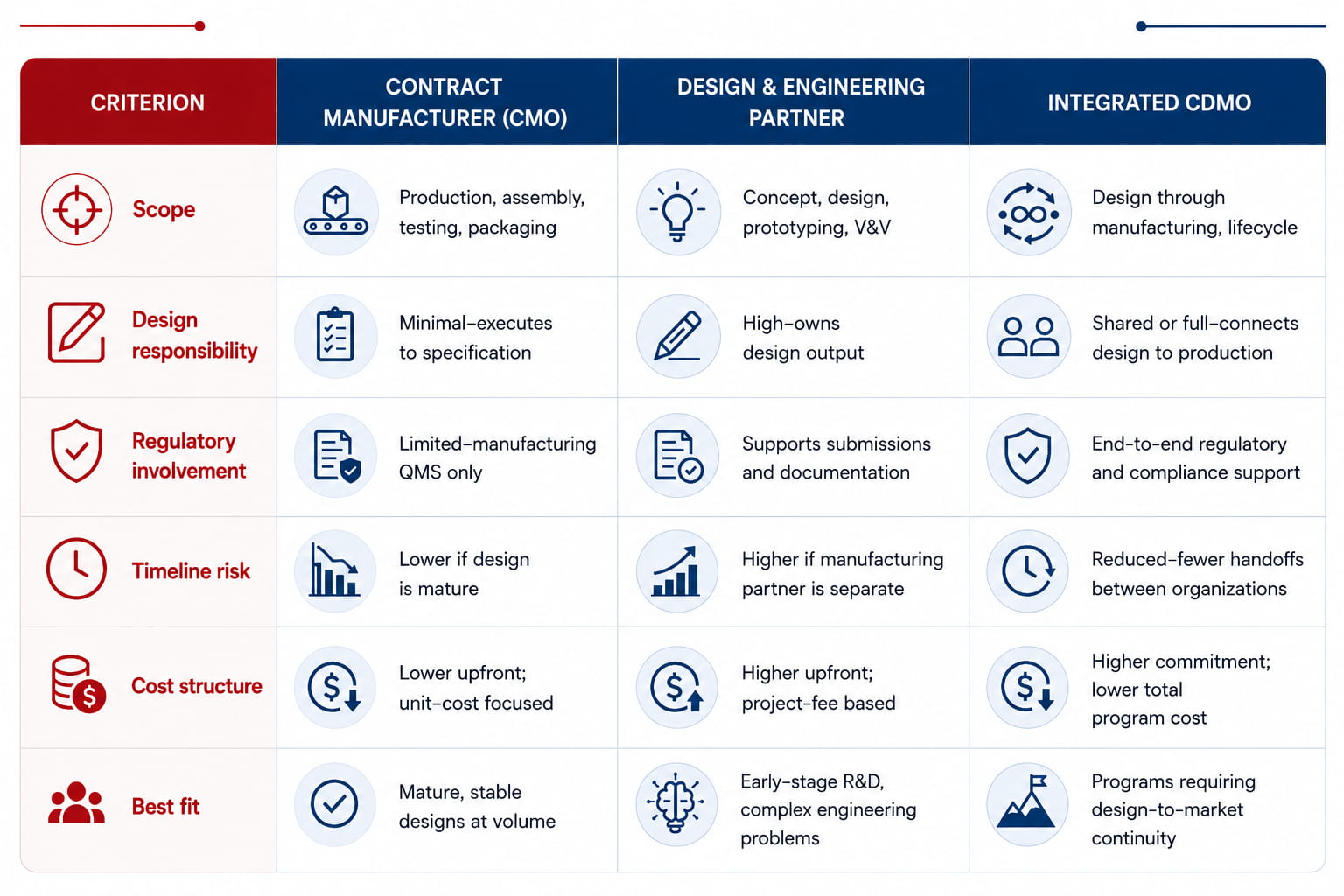
The appropriate model ultimately depends on the level of support and integration required across the product lifecycle. Evaluating these factors can help companies select an outsourcing structure that aligns with their technical requirements, business objectives, and long-term commercialization plans.
Regulatory and Quality Considerations
Regulatory readiness is non-negotiable in the medical device industry. Companies must evaluate whether their outsourcing partner operates under robust quality management systems, holds relevant certifications such as ISO 13485:2016, and has a strong experience supporting the regulatory requirements.
Certifications alone, however, do not show the entire picture. In addition to certifications, it is important to assess documentation standards, audit history, and the partner’s ability to maintain compliance throughout the product lifecycle. The recent IMDRF draft guidance on supplier controls (published May 2026) reinforces that OEMs retain legal responsibility for outsourced activities, making it even more essential that partners demonstrate strong, auditable quality and compliance systems.
As regulatory expectations around outsourced activities continue to evolve, strong communication and project management are equally important to ensure that responsibilities remain clearly defined and requirements are addressed as programs progress.
Syrma Johari Medtech’s regulatory experience across international markets has established a strong foundation for supporting global medical device programs. With ISO 13485:2016 certification and experience across regulatory pathways including FDA 510(k) and CE marking, SJML supports medical device programs targeting international markets.
Managing Common Outsourcing Risks
Even well-planned outsourcing programs can encounter challenges. Identifying common risks early can help companies protect timelines, costs, product quality, and regulatory readiness.
Design-manufacturing Disconnects
A design may perform well technically but prove difficult to manufacture consistently at scale due to assembly, tolerancing, testability, or material constraints.
Solution: Involve manufacturing and supply-chain expertise early and incorporate DFM/DFA reviews before the design is frozen.
Regulatory Compliance Gaps
Incomplete documentation, inadequate risk management, or misaligned verification and validation can create costly rework during submissions or audits.
Solution: Establish the regulatory strategy early and work with partners experienced in the requirements of the target markets. SJML supports this approach through QARA-centric manufacturing that integrates regulatory compliance into every stage.
Supply Chain and Component Obsolescence
Single-source components, supplier disruptions, and shortened component lifecycles can threaten production continuity. Single-source dependencies and sterilization capacity constraints could also delay production. A recent example is FDA’s decision to flag ethylene oxide sterilization bottlenecks as a supply chain vulnerability.
Solution: Use supplier qualification, alternate sourcing, component lifecycle monitoring, and proactive obsolescence management to reduce supply risks. A partner with a robust supplier assessment programme and proactive BOM management reduces the risk of post-launch interruptions in production.
Intellectual Property Protection
Outsourcing medical device manufacturing involves sharing proprietary designs, specifications, and potentially, source code. Without proper safeguards, companies risk IP leakage, unclear ownership terms, or misuse of confidential information.
Solution: Robust intellectual property protection is essential when outsourcing medical device manufacturing. Establish comprehensive NDAs and master service agreements with clear IP assignment clauses before any technical information is shared. Prioritize partners with ISO 27001 certification or equivalent information security management systems. Ensure secured IT infrastructure, encrypted data transfer, and contractual liability provisions. Protect your competitive advantage through documented, enforceable agreements-not just good faith.
From Evaluation to Action: Choosing the Right Path Forward
Medical device outsourcing is most effective when treated as strategic product and commercialization strategy. The right outsourcing partner can connect design, engineering, regulatory compliance, manufacturing, supply chain, quality, scale-up, and lifecycle requirements to create greater continuity across the product program.
The global medical device outsourcing market is projected to grow by over $50 billion between 2024 and 2028, with the U.S. market alone reaching USD 34.41 billion in 2025 and growing at approximately 13.0% CAGR through 2030. This growth reflects a structural shift – many medical device companies are moving away from fragmented supplier networks and toward integrated partnerships, considering it reduces overall risk and accelerates commercialization. India is increasingly seen as a low-cost manufacturing hub for medical devices, offering a combination of skilled engineering talent, a growing regulatory infrastructure, and competitive cost structures for companies seeking to diversify their global manufacturing.
For companies evaluating an outsourcing strategy, the right model ultimately depends on the product’s development stage, internal capabilities, risk profile, and long-term objectives. A mature product with established specifications may require specialized contract manufacturing, while a complex or early-stage program may benefit from a more integrated CDMO model. In either case, evaluating a partner’s technical expertise, quality systems, regulatory experience, manufacturing capabilities, scalability, and lifecycle support is critical.
To move forward effectively:
1. Assess your current program requirements: Identify which capabilities should remain internal and where external expertise can strengthen design, engineering, compliance, and manufacturing.
2. Evaluate potential partners against structured criteria: Look beyond cost and production capacity to assess technical depth, quality systems, regulatory experience, supply-chain capabilities, and scalability. See these critical steps to consider before outsourcing for a practical framework.
3. Match the outsourcing model to the program: Consider whether a CMO, specialized design partner, or integrated CDMO best aligns with your product requirements, timeline, risk profile, and internal resources.
4. Engage early: Bringing manufacturing, sourcing, quality, and regulatory considerations into development earlier can help identify potential challenges before they become costly downstream issues.
SJML supports medical device companies across these stages, from design and engineering through contract manufacturing and product lifecycle management, with its integrated MedTech CDMO model. If you are evaluating an outsourcing, design-transfer, scale-up, or manufacturing requirement, you can connect with the SJML team to discuss your program.
Additional Resources
The following standards and guidance documents are essential references for companies evaluating medical device outsourcing partnerships:
- ISO 13485:2016 – Quality management systems for medical devices
- ISO 14971:2019 – Risk management for medical devices
- IEC 62304 – Software life cycle processes for medical device software
- IEC 60601 series – Electrical safety and essential performance
- IEC 62366 – Usability engineering for medical devices
- ISO 10993 – Biological evaluation of medical devices
- MDSAP – Medical Device Single Audit Program (multi-jurisdictional audit recognition)
- EU MDR (2017/745) / IVDR (2017/746) – European medical device and in vitro diagnostic regulations
- FDA 21 CFR Part 820 – Quality System Regulation
- IMDRF draft guidance on supplier controls (May 2026) – Risk-based lifecycle oversight of outsourced activities
Learn more about the new product introduction process for medical devices in SJML’s latest blog.