
Electrical stimulation is a type of therapeutic treatment that can serve many different purposes in physical therapy. It can be used to decrease pain and inflammation, improve circulation, and help muscles contract properly.
Electrical stimulation is often used to support a physical therapy program after an injury or illness.
It is an incredible technology with the potential to dramatically change the way we restore and enhance the human body. Changing times demand a more non-invasive approach to pain alleviation and elimination.
How Did Electrical Stimulation Begin?
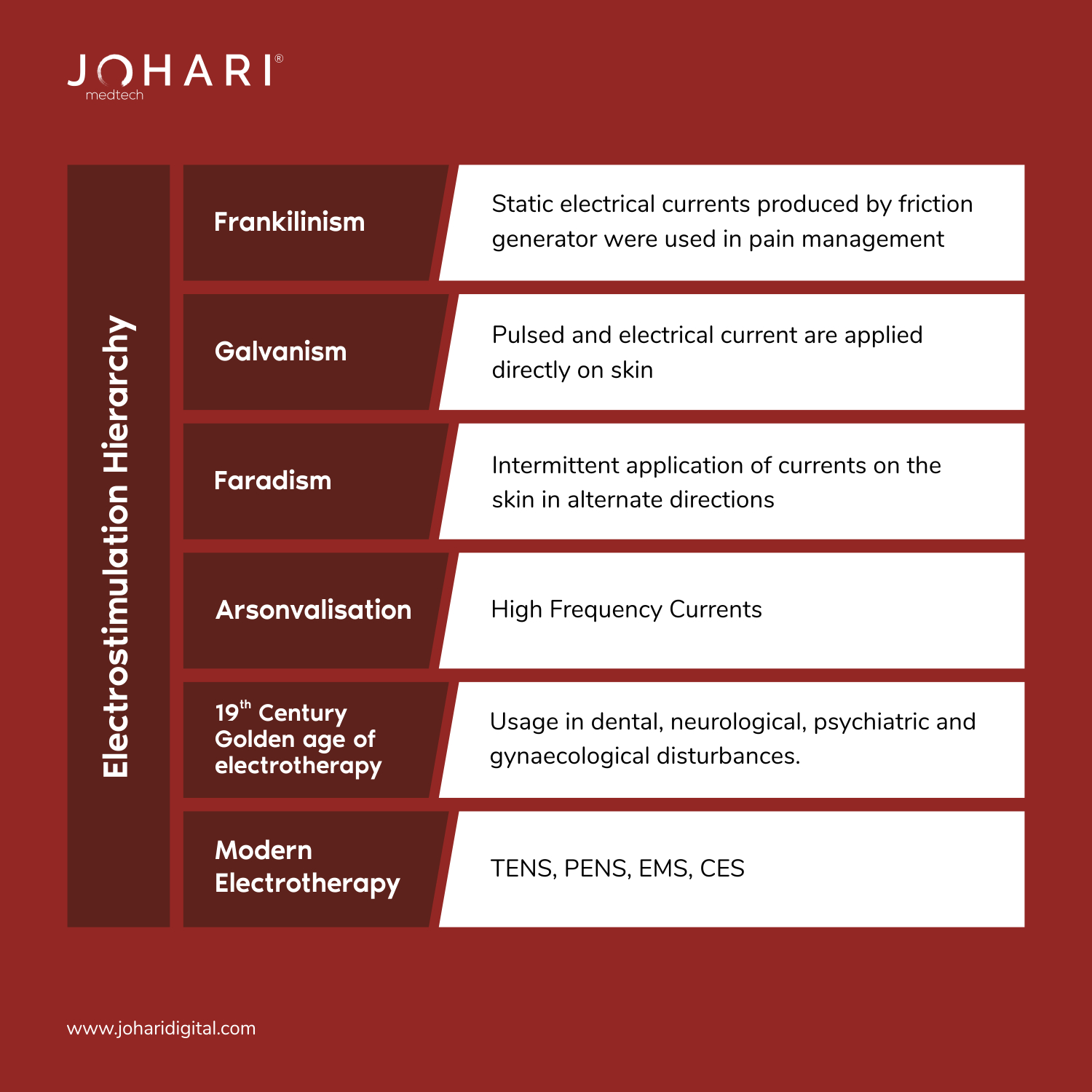
The use of electricity for pain relief dates back many years. The use of currents in pain management has evolved through several phases over time.
Different Types of Electrical Stimulation
Electrical stimulation is used in many ways to alleviate pain and reduce stress. Physiotherapists use different waveforms for different types of pain in physiotherapy clinics.
The following are some of the commonly used types of electrical stimulation in physical therapy:
Transcutaneous Electrical Nerve Stimulation (TENS)
Interferential Current (IFC) Electrical Stimulation
High Voltage Electrical Stimulation
Electrical Muscle Stimulation (EMS)
Functional Electrical Stimulation (FES)
Neuromuscular Electrical Stimulation (NMES)
Russian Electrical Stimulation
Galvanic Electrical Stimulation
Faradic Electrical Stimulation
1. TENS — Transcutaneous Electrical Nerve Stimulation
Transcutaneous Electrical Nerve Stimulation, also known as TENS, is one of the oldest and most widely used forms of electrical stimulation for pain relief.
TENS uses low-voltage electrical current to provide pain relief. A TENS unit consists of a battery-powered device that delivers electrical impulses through electrodes placed on the surface of the skin.
The electrodes are placed at or near the nerves where pain is located, or at trigger points.
Indications
Arthritis
Fibromyalgia
Knee pain
Back pain
Neck pain
Diabetic neuropathy
Pelvic pain from periods or endometriosis
Example: Stimtec2
2. Interferential Current (IFC) Electrical Stimulation
Interferential therapy uses two medium frequencies in a manner that does not usually cause major side effects.
The sensation induced by IFT varies according to the different AMF settings. Lower AMF generates a tapping or beating sensation, while higher AMF generates a buzzing or tingling sensation.
Approximately 10 to 15 minutes are needed to properly deliver the impact of IFT to the affected area.
Indications
Muscle spasm
Edema
Hematoma
Chronic ligament lesion
Radiculopathy
Stress incontinence
Example: Stim3
3. High Voltage Electrical Stimulation
High Voltage Electrical Stimulation is a type of electrical stimulation commonly used in deep wound healing.
This process may improve healing time by enhancing blood flow and supporting the replacement of lost cells. It helps create a better environment for healing and recovery.
Indications
Adhesive bursitis
Wound healing
Cervical sprain
Degenerative disc
Epicondylitis
Sprain
Post-operative pain
Example: Analgesic Pulser 439 Plus
4. Electrical Muscle Stimulation (EMS)
Electrical Muscle Stimulation, also known as EMS, is primarily used for facial muscle stimulation and in neurological conditions such as Bell’s Palsy.
Electrical stimulation is a modern technique that supports pain and stress relief without compromising the body’s metabolism. It is also used for muscle strengthening, conditioning, and weight management.
Indications
Physical rehabilitation
Weight loss
Muscle spasm relaxation
Restoration of lost functionality
Atrophy
Example: NMS-498
5. Functional Electrical Stimulation (FES)
Functional Electrical Stimulation, or FES, uses low electric currents to create sensations that stimulate the body to restore lost functionality.
In cases of paralysis or loss of function, FES can be highly valuable. It is especially important for people who have lost the ability to walk or move.
FES may also support certain levels of bowel and bladder function. In cases where a person cannot perform general functions such as breathing, grasping, transferring, standing, or walking, FES plays an important role.
Indications
Regaining lost functionality
Paralysis
Lost muscle functionality
6. Neuromuscular Electrical Stimulation (NMES)
Neuromuscular Electrical Stimulation is applied to a group of muscles. Repetitive contractions help retrieve lost functionality.
This treatment is important for retraining and strengthening weak muscles, including urinary muscles.
Indications
Incontinence
Muscle rehabilitation
Muscle weakness
Neuromuscular re-education
7. Russian Electrical Stimulation
Russian current is a medium-frequency current generally used for strengthening and muscle re-education. The current is applied in alternating pulsed or burst mode.
Indications
Muscle strengthening
Muscle re-education
Quadriceps strengthening
8. Galvanic Electrical Stimulation
Galvanic Electrical Stimulation uses an interrupted direct current, commonly at a frequency of 30 pulses per minute.
The galvanic current works on neural endings. The cathode electrode enhances nerve sensitivity, while the anode helps reduce pain. The process involves disrupting pain signals to alleviate or eliminate pain.
Galvanic stimulation is often used on denervated muscles to produce the desired effect.
Indications
Axonotmesis
Neurotmesis
Improving skin elasticity
Minimizing fine lines and wrinkles
Boosting blood circulation and oxygen levels in the skin
9. Faradic Electrical Stimulation
Faradic Electrical Stimulation uses an interrupted direct current with a frequency of 50–100 Hz and a pulse duration ranging from 0.1 to 1 ms.
It is highly effective in innervated muscles and may feel like a prickling sensation during application. The stimulation causes a reaction in the motor nerves of the treated area.
Faradic stimulation acts on innervated muscles, which differentiates it from galvanic stimulation in terms of physiological effect.
Indications
Muscle re-education
Pain relief in knee syndrome
Muscle atrophy
Restoration of nutrient blood flow in the treated area