Key Takeaways
- The AI advantage is shifting from software to hardware. With over 1,300 FDA-authorized AI medical devices, algorithmic capability is no longer the primary differentiator.
- Every AI medical device has to solve the same four hardware challenges. Edge compute, sensor fusion, firmware co-design, and on-device regulatory complexity are not optional. It’s better to address them early than to spend a long time retrofitting.
- A software decision is never just a software decision. Changing the AI model can change the thermal profile, the firmware validation cycle, and the regulatory timeline of the device.
- Regulatory tooling is evolving but not solving the burden. The FDA’s 2024 PCCP guidance helps with model updates, but changes to intended use or model architecture still triggers full resubmission.
- AI MedTech’s next moat is integrated execution. Companies that lead will be those which tackle issues of BOM, the cleanroom, and the Notified Body effectively.
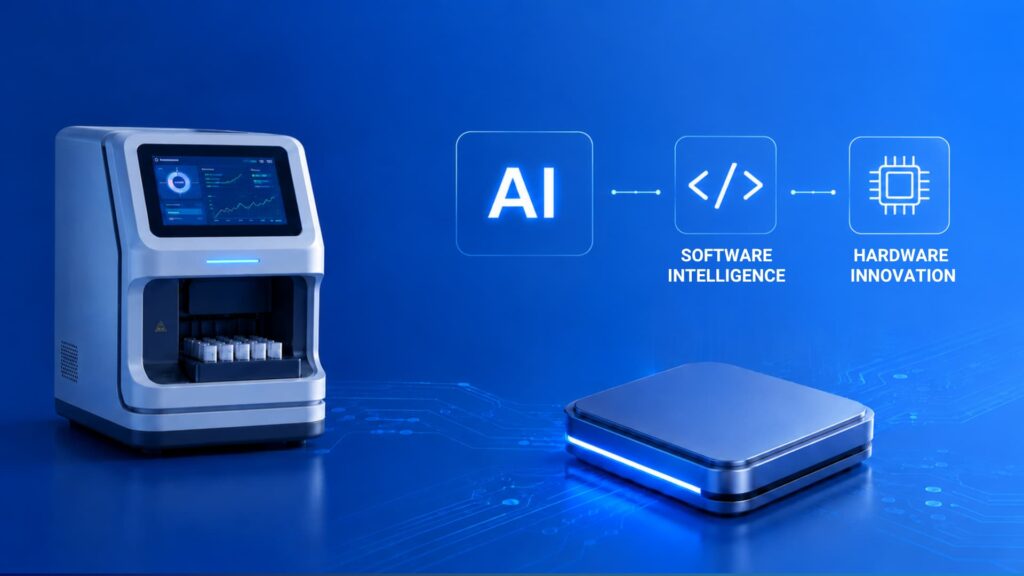
AI in MedTech is moving past the algorithm era. The next frontier (edge compute, sensor fusion, firmware co-design, and SaMD-on-device compliance) is increasingly a hardware execution challenge.
According to the FDA’s AI/ML-Enabled Medical Device List, more than 1,300 AI-enabled medical devices have been authorized for the US market as of its December 2025 update, part of a roughly 350% rise in clearances over the past five years. But it is worth looking at where those authorizations cluster. Around three-quarters are radiology imaging software, while the harder categories, including integrated diagnostics, continuous monitoring, point-of-care intelligence, cardiovascular AI, and antimicrobial susceptibility platforms, remain comparatively under-represented.
There is a reason for the imbalance. The algorithms are increasingly commoditized. The integrated hardware they run on is not.
The next MedTech differentiator is less about the model itself and more about the manufacturability, integration, and regulatory packaging of the device the model lives inside. This article maps the four hardware layers that tend to determine which AI MedTech companies reach commercial scale, and which remain in pilot.
Why AI MedTech’s Bottleneck Has Shifted From Software to Silicon
Open-source models, foundation models, and cloud APIs have steadily lowered the barrier to building software-only AI in healthcare. Capabilities that were genuinely differentiating two years ago are now widely accessible, and a small team can fine-tune a diagnostic-grade model in a matter of weeks.
The radiology concentration in FDA filings reflects this. Imaging software is the most manageable category: cloud-resident, validated against established datasets, and classifiable as a standalone Software as a Medical Device. The harder categories, which involve integrated sensors, on-device inference, multi-modal inputs, and embedded firmware, are progressing more slowly, precisely because the execution problem remains unsolved.
In other words, this is as much a manufacturing and integration challenge as it is a data-science one.
The companies that lead the next phase of AI MedTech are unlikely to be the ones with the marginally better model. They will be the ones who have worked out how to manufacture the device that is reliable at scale, under audit, and across multiple regulatory geographies.
The Four Hardware Layers Behind Every AI Medical Device
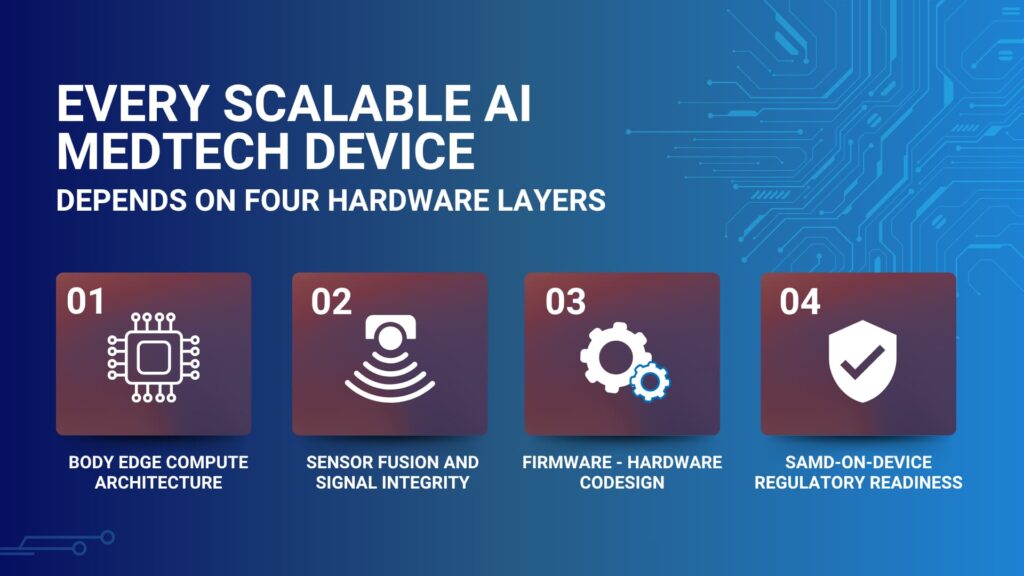
Across most AI medical devices that reach commercial scale, the same four hardware layers tend to determine success. Each is a manufacturability problem in the shape of an engineering problem, and each compounds the next.
Layer 1: Edge Compute Architecture
AI inference is steadily moving from the cloud onto the device. The drivers are well understood: latency thresholds in clinical decision support, patient-data privacy obligations, intermittent connectivity in field deployments, and the practical reality that some clinical devices cannot depend on a stable round-trip to a remote server.
On-device inference, however, introduces a trade-off between thermal envelope, power budget, and bill-of-materials cost. The choice of NPU or MCU influences enclosure design, heat dissipation strategy, and battery sizing. A wearable continuous monitor running a lightweight model on a low-power MCU has a very different chassis, battery, and cost profile from a point-of-care diagnostic running a heavier model on an embedded NPU. The AI ambition may be similar; the resulting devices are not.
The practical implication is that the device architecture becomes dependent on the model. A meaningful change to the model can change the thermal profile, which in turn can change the physical device. For this reason, architecture decisions are best made jointly with a hardware partner early in development, rather than after the algorithm is considered finished.
SJML’s integrated design-and-manufacturing model is built around exactly this kind of joint decision-making, with silicon selection, thermal design, enclosure engineering, and BOM trade-offs handled under one roof from day one.
Layer 2: Sensor Fusion and Signal Integrity
The quality of an AI system’s output is ultimately limited by the quality of its sensor inputs. A model trained on clean data will struggle the moment it encounters noisy signals from real-world hardware.
Multi-modal medical devices, which may combine RF, ultrasound, optical, and electrochemical sensing in a single enclosure, depend on disciplined EMI/EMC engineering, careful analog front-end design, and unit-to-unit calibration that remains stable across large production runs. The accuracy demonstrated in a pilot is the accuracy the manufacturing line then has to reproduce consistently, over years of output.
SJML’s Technology Accelerators are designed to help in these cases. The RF, Biostimulation, Ultrasound, and Point-of-Care Diagnostics platforms act as pre-validated sensor-fusion building blocks: modular hardware foundations that can shorten integration timelines for AI MedTech companies and reduce signal-integrity risk early in the program.
Layer 3: Firmware and Hardware Co-Design
AI in medical devices rarely ships as standalone software. More often, it ships as firmware, bound to particular silicon, sensors, and actuators, where there is no straightforward equivalent of a routine over-the-air update.
Each model revision can cascade downstream into requalification under ISO 14971, re-verification of intended use, change-control documentation, and, in some cases, resubmission to regulators. A change that appears minor is not necessarily minor once the device is regulated. Consider a retrained model that improves diagnostic accuracy by two percentage points but also alters the required sensor sampling rate. That single dependency can lead to months of verification work, updated risk-analysis documentation, and a Notified Body review that was not in the original plan.
Teams that treat firmware lifecycle as a later-stage concern often spend considerable time retrofitting update pathways into devices that were never designed to receive them. Designing those pathways from the start, with a manufacturing partner involved, makes it far more feasible to ship model updates without repeatedly restarting the regulatory process.
Layer 4: SaMD Regulatory Complexity
When AI is embedded in a physical medical device, several regulatory frameworks can apply at once: MDR/IVDR for the device, the EU AI Act for the algorithm, and cybersecurity expectations, including FDA premarket cybersecurity guidance and NIS2.
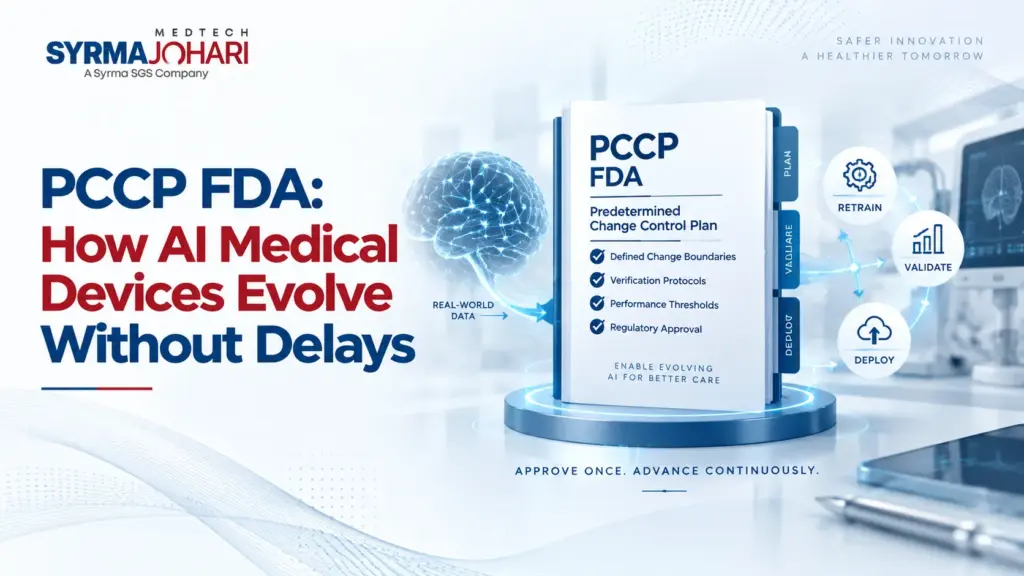
Each model retrain can also count as a potential “significant change” requiring fresh review. The FDA’s draft Predetermined Change Control Plan (PCCP) guidance for medical devices (August 2024) acknowledges this and proposes a structured path for pre-authorized model updates, though it does not remove the underlying burden. A PCCP can cover retraining within a defined performance envelope on a specified data distribution. It generally cannot cover a change in intended use, a new sensor input, or a shift in model architecture, all of which can still require full resubmission. Understanding where that boundary sits, before the device leaves engineering, is often the difference between an update measured in weeks and one measured in months.
Put simply, the difficulty is no longer building AI into devices. It is building AI into devices without repeatedly resetting the regulatory clock.
SJML’s expertise in navigating complex cross-domain regulatory challenges is well established. A digital health company developing an AI-enabled SaMD for arthritis screening approached SJML with no defined regulatory pathway, no classification clarity, and no QMS in place. SJML defined the SaMD regulatory strategy and intended use, built an ISO 13485-aligned QMS framework, developed SDLC, validation, and risk documentation, and delivered audit-ready SOPs and a training package.
The result: A company that arrived with an AI concept left with a market-ready SaMD, regulatory clarity, and a fully documented compliance framework.
From Demo to Deployed: Where AI Medical Devices Get Built
A working demonstration needs to succeed once. A deployed AI medical device has to perform consistently across supply chains, audits, EMC testing, firmware revisions, and large-scale production. That gap, between a successful demonstration and dependable deployment, is where many AI MedTech programs slow down, and it is the part of the journey where SJML concentrates its work.
Hemex Health is a point-of-care diagnostics company with AI-enabled platforms, focused on miniaturized electrophoresis devices for conditions including Sickle Cell disease, Thalassemia, and Anaemia, and are expanding into broader diagnostics. As Hemex Health’s exclusive Contract Equipment Manufacturer, SJML supports the design, development, and manufacturing of these platforms, working across ISO 13485, CE IVDR, FDA 510(k), and CDSCO frameworks. To date, that partnership has supported more than 2,800 deployed readers and 1.68 million tests across 44 international markets.
“SJML has evolved into a strategic partner, collaboratively tackling design and production challenges. Their robust practices, in-house PCBA, and strong supply chain management significantly increased product quality, boosting efficiency five-fold and substantially reducing manufacturing costs.” — Hemex Health
The wider point is straightforward: software expertise alone does not deliver a manufacturable, compliant, deployable device. Integrated development and manufacturing capability does.
The Next Frontier
As AI-powered healthcare continues to scale through 2027 and beyond, the companies that lead are unlikely to be distinguished by model architecture alone. They are more likely to be distinguished by whether their advantage holds up against the realities of the BOM, the cleanroom, and the Notified Body.
The next meaningful bottleneck in AI MedTech is less about generating clinical intelligence and more about the infrastructure required to commercialize it.
As algorithmic capability becomes more evenly distributed, the durable advantage increasingly lies in the manufactured device underneath.
Building an AI-Enabled Medical Device?
The hardware, integration, and regulatory work is often where timelines slip. Syrma Johari MedTech Limited partners with AI MedTech companies to manufacture, validate, and ship devices that meet MDR, FDA, and IVDR expectations from the outset.
FAQs
Open-source models, foundation models, and cloud APIs have lowered the barrier to building diagnostic-grade AI. What now determines whether an AI medical device reaches commercial scale is the integrated hardware it runs on: edge compute architecture, sensor design, firmware lifecycle, and regulatory packaging. These are manufacturing and engineering challenges, not data-science ones.
Edge compute architecture (where the AI inference happens, and the thermal and power trade-offs it imposes); sensor fusion and signal integrity (the upstream quality that caps model performance); firmware and hardware co-design (how model updates cascade into regulatory requalification); and SaMD regulatory complexity (the simultaneous obligations across MDR/IVDR, the EU AI Act, and cybersecurity frameworks).
PCCP is a regulatory mechanism that allows AI medical device manufacturers to pre-authorize certain types of model updates without filing a new marketing submission for each change. The FDA’s draft guidance applies specifically to AI-enabled device software functions. A PCCP can cover retraining within a defined performance envelope. It generally cannot cover changes to intended use, new sensor inputs, or shifts in model architecture, all of which can still trigger full resubmission.
When AI is embedded in a physical medical device rather than running as standalone software, multiple regulatory frameworks apply at once: MDR/IVDR for the device, the EU AI Act for the algorithm, and cybersecurity expectations, including FDA premarket cybersecurity guidance and NIS2. Every meaningful model change can also count as a “significant change” requiring fresh review.
SJML works as an integrated CDMO partner across design, development, and manufacturing for AI-enabled medical devices. Capabilities include in-house PCBA, pre-validated Technology Accelerators (RF, Biostimulation, Ultrasound, Point-of-Care Diagnostics) that compress sensor-fusion integration timelines, supply chain management, and the PFASight compliance platform for unified BOM and regulatory workflows. SJML is the exclusive Contract Equipment Manufacturer for Hemex Health, helping them reach over 2,800 deployed readers and 1.68 million tests across 44 international markets.
The commonly applicable frameworks include ISO 13485 for medical device quality management, ISO 14971 for risk management, CE IVDR or MDR for European market access, FDA 510(k) or PMA for US market access, MDSAP for multi-country audit recognition, and CDSCO for India. AI-specific overlays include the FDA’s PCCP guidance and the EU AI Act.