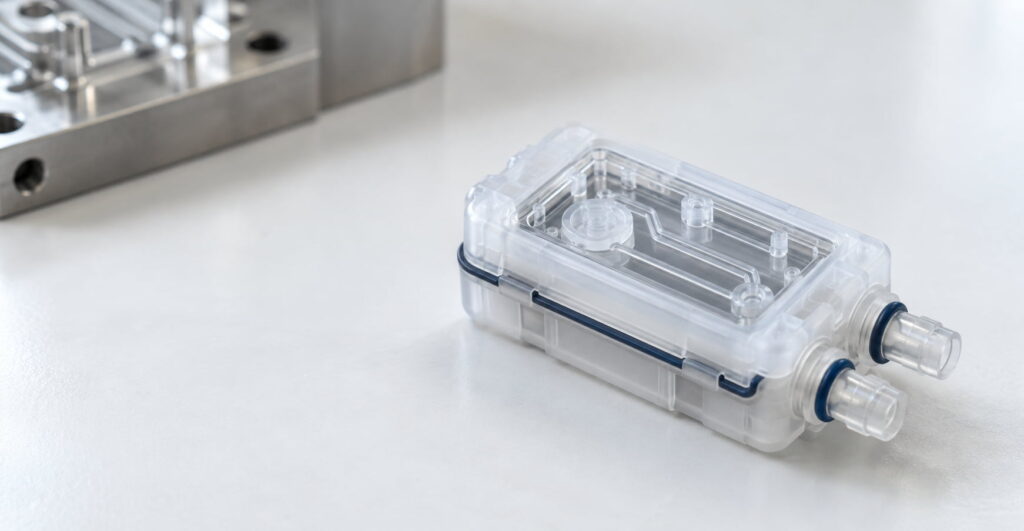
Medical device cartridges may appear to be relatively simple components, but they are used in highly sensitive applications such as managing drugs, reagent, or other fluids. Medical cartridge production involves a combination of precise geometries, sealant requirements, functional interfaces, and assembly features.
Given the sensitivity involved, resin selection directly influences how a cartridge performs. Factors such as material compatibility, dimensional stability, surface characteristics, sealing, and molding consistency directly affect critical aspects such as fluid control, containment, and detection reliability.
As cartridge designs become application-specific, it is important to consider manufacturability alongside the design process. It is important to evaluate polymer selection, tooling strategy, component geometry, and process parameters in tandem.
The persisting challenge for medical device cartridge manufacturers is establishing a repeatable process wherein factors such as critical engineering features and control variation can be maintained without compromising performance.
What are the Major Challenges in Medical Cartridges?
Despite rising demand for medical cartridges, manufacturers continue to face challenges in maintaining consistent quality at scale. Medical cartridges can use materials such as polypropylene (PP), polyethylene (PE), polycarbonate (PC), cyclic olefin polymers/copolymers COC/COP, and specialty engineering polymers, depending on the application.
While a broad range of polymers is available across the world, the pool of ‘qualified’ materials and suppliers is relatively narrow, especially for specialty grade cartridges. Changing the base resin or supplier can require reassessment of material compatibility, processing characteristics, dimensional performance, biocompatibility, and other application-specific requirements. To add to that, juggling raw material providers is not as straightforward considering that changing the base resin requires evaluation of:
1. Material compatibility
The cartridge must be compatible with the material that it transports, in addition to sustaining external factors. For polymer cartridges, this can involve chemical compatibility, biocompatibility, extractables and leachables, barrier properties, and sterilization compatibility.
2. Dimensional precision
Many cartridges have critical interfaces with plungers, seals, needles, valves, connectors, or device housings. Even minor dimensional variations can affect sealing, fluid flow, dosing, insertion, or assembly.
3. Sealing and containment
A cartridge must maintain a controlled internal environment or prevent leakage during storage, transportation, and use. Sealing may be affected by factors such as geometry, surface finish, material properties, dimensional consistency, and assembly.
4. Complex molding and geometries
Medical cartridges can incorporate channels, ports, threads, and undercuts. Producing these features repeatedly through injection molding requires optimal tooling design and appropriate process control.
5. Integration with medical devices
Since cartridges imperatively react with the medical devices, factors such as tolerance stack-up, interfaces, locking mechanisms, fluid pathways, and component alignment can directly affect the performance of the final assembly.
What are the Different Medical Cartridge Types?
Medical cartridges are designed specifically around the function they perform within a medical device. Their requirements can vary considerably depending on what they contain, how they interact with the device, and how they are used. Broadly, medical cartridges can be classified as:
| Type | What It Does | Where Precision Matters |
|---|---|---|
| Drug-Delivery | Contains and delivers pharmaceutical formulations | Sealing, dosing, drug compatibility |
| Diagnostic & Reagent | Manages samples, reagents, and diagnostic reactions | Fluidics, dimensional accuracy, contamination control |
| Sample-Processing | Prepares biological samples for analysis | Filtration, metering, separation, fluid control |
| Fluid-Management | Routes, stores, mixes, or regulates fluids | Fluid pathways, sealing, valves, interfaces |
| Functional | Houses or positions precision components | Alignment, mechanical integrity, device interface |
1. Drug-delivery cartridges
Drug-delivery cartridges are designed to contain and deliver a pharmaceutical formulation through a medical device. They are mostly used in applications such as injection and infusion systems, wherein the cartridge design must align with drug compatibility, containment, sealing, dose accuracy, and reliable interaction with the delivery mechanism.
2. Diagnostic and reagent cartridges
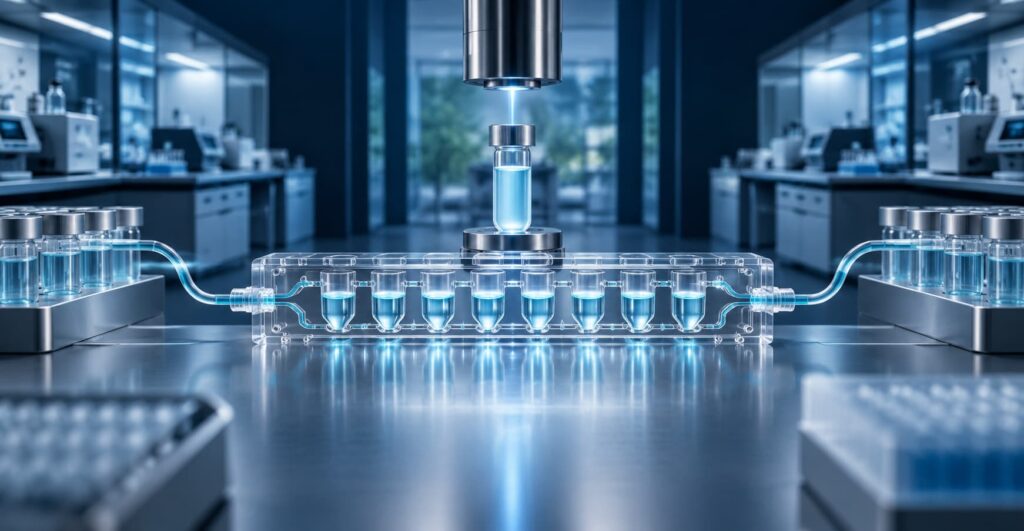
Diagnostic cartridges are used in diagnostic and point-of-care systems to facilitate the detection or analysis of a target. They may incorporate reagents, reaction chambers, fluidic pathways, filters, or other functional elements required to perform an assay. Consistent fluid handling, dimensional accuracy, material compatibility, and contamination control are particularly important in these applications.
3. Sample-processing cartridges
Sample-processing cartridges are designed to receive and prepare biological samples before or during analysis. Depending on the application, they can incorporate functions such as filtration, separation, mixing, metering, or sample transfer. Their design therefore needs to support controlled fluid movement and reliable integration of multiple processing steps within a compact format.
4. Fluid-management cartridges
Fluid-management cartridges control, route, store, mix, or otherwise manage fluids within a medical device. These cartridges can incorporate channels, valves, ports, membranes, and other interfaces to regulate fluid movement. Factors such as dimensional precision, sealing performance, material compatibility, and reliable device integration are critical to the functionality of these cartridges.
5. Functional cartridges
Not all medical cartridges are designed primarily to contain a drug, reagent, sample, or other fluid. In some requirements, cartridges are required to function as housings or platforms for precision components within a medical device. A relevant example would be microneedling needle-array cartridges, wherein they simply position arrays of fine needles while providing the interface between the disposable cartridge and the device handpiece. For functional cartridges, factors such as mechanical precision, component alignment, secure attachment, and repeatable performance are decide the overall performance.
How Does Material Selection Influence Medical Cartridge Performance?
Material selection is one of the earliest and most consequential decisions in medical cartridge development. The resin selection depends on the cartridge’s application, contents, performance requirements, and manufacturing process.
Chemical and application compatibility
The polymer must remain compatible with the drug, reagent, biological sample, or other fluid it is intended to contain or transport. Depending on the application, this may involve evaluating chemical compatibility, biocompatibility, extractables and leachables, and other material-fluid interactions.
Dimensional and mechanical stability
Material properties such as shrinkage, thermal behavior, and mechanical stability can influence how consistently critical cartridge features are reproduced during molding. This is particularly important for interfaces involving seals, plungers, valves, connectors, and device housings.
Sterilization compatibility
The selected polymer must be able to withstand the sterilization method used for the finished component or device without compromising its dimensions or functional properties. Sterilization requirements should therefore be considered during material selection rather than addressed later in development.
Surface and optical properties
Surface characteristics can influence fluid movement, sealing, bonding, and other functional interactions within the cartridge. For diagnostic applications, properties such as transparency and optical consistency may also be important where visual or optical detection is involved.
Manufacturing considerations
Different polymers have different melt-flow characteristics, processing windows, shrinkage behavior, and cooling requirements, all of which can affect injection molding. These characteristics can influence mold filling, warpage, cycle times, dimensional consistency, and the repeatability of complex geometries.
Ultimately, material selection should not be considered in isolation. Evaluating the material alongside cartridge geometry, tooling strategy, molding parameters, assembly requirements, and quality specifications can help establish a more robust path from design to production.
What Does the Medical Cartridge Manufacturing Process Involve?
Medical cartridge manufacturing involves more than injection molding the final component. The process typically brings together design evaluation, material selection, tooling, molding, inspection, and quality controls to ensure that the cartridge can be produced consistently and perform as intended.
Design and manufacturability assessment: The cartridge design is evaluated against its functional, dimensional, tooling, and assembly requirements to determine whether it can be manufactured consistently at the intended production volume.
Tooling development: Tooling needs to be designed around the cartridge geometry, material, required tolerances, and expected production volumes. Factors such as gate location, cooling, ejection, and cavity configuration can influence part quality and process repeatability.
Precision injection molding: During molding, process parameters such as temperature, injection speed, pressure, and cooling need to be controlled to consistently reproduce the required geometry. Process conditions can directly influence dimensional accuracy, warpage, surface quality, and overall part consistency.
Inspection and quality control: Critical cartridge features need to be inspected against defined specifications to identify dimensional, visual, and functional variation. Depending on the application, this may include dimensional inspection, leak testing, visual inspection, or other application-specific checks.
Assembly and functional integration: For cartridges incorporating seals, plungers, valves, needles, connectors, or other components, assembly directly influences the overall performance. Factors such as component alignment, fit, sealing, and interface consistency need to be maintained across production.
Process validation and scale-up: Before moving into production, the manufacturing process needs to demonstrate that it can consistently produce components meeting defined requirements. Establishing appropriate process controls and monitoring can help maintain this consistency as production volumes increase.
Why is Design for Manufacturability Important for Medical Cartridges?
Design for Manufacturability (DFM) helps ensure that a cartridge that is designed to meet specific functional requirements can also be manufactured consistently at production scale. Factors such as wall thickness, draft angles, tolerances, undercuts, parting lines, and critical interfaces need to be considered alongside the intended function of the cartridge. These design elements can influence mold filling, cooling, part ejection, dimensional stability, and the overall repeatability of the molding process.
If these considerations are addressed early, manufacturers can minimize tooling modifications, molding challenges, assembly issues, and dimensional variation later in the development process. This is particularly important for medical cartridges, where even small variations can affect sealing, fluid flow, component alignment, or interaction with the final device. Since cartridges often need to integrate precisely with seals, plungers, valves, connectors, or device housings, aligning design intent with manufacturing capability from the outset can help establish a more controlled and predictable path to repeatable production.
What Makes a Medical Cartridge ‘Production-ready?’
The biggest challenge for cartridge manufacturers is the ability to translate material and design specifications into precise, repeatable components at production scale. As cartridge geometries become more complex and applications become more demanding, manufacturers require infrastructure capable of maintaining tight process controls while accommodating different engineering polymers, tooling configurations, and component geometries.
For manufacturers, the focus should not be on molding alone. Factors such as material selection, tooling, process development, precision injection molding, inspection, and quality control also have a significant say in how well a cartridge performs.
SJML’s medical plastics and injection molding facility is developed based on an infrastructure that supports controlled polymer processing. The new facility incorporates a quality-by-design “QbD” approach, placing a detailed focus on each phase within the development lifecycle.
How can Cartridge Production be Scaled?
Ultimately, a ‘production-ready’ medical cartridge is defined by how consistently its performance can be reproduced at scale. As cartridge designs continue to incorporate more complex geometries, materials, and functional interfaces, manufacturing considerations need to be addressed from the outset. Aligning material selection, tooling, molding, process control, inspection, and quality requirements can help translate a functional cartridge design into a reliable, scalable medical device component.
Building scalable medical cartridges therefore requires a manufacturing strategy that connects design intent with material behavior, process capability, quality requirements, and production scalability. For medical device manufacturers, considering these factors early can help establish a more controlled path from initial design to repeatable production.
For cartridges used in diagnostic and IVD applications, these considerations become particularly important as fluidics, assay requirements, and component integration converge within increasingly compact platforms. Explore SJML’s diagnostics capabilities to learn more about its approach to developing and manufacturing components for diagnostic and IVD applications.