
For R&D and post-market leaders, product sustenance was formerly focused on maintenance. Today, it’s a strategic growth imperative. Regulatory burdens, BOM volatility, and pricing compression have compelled MedTech organizations to reassess the true meaning of value engineering in medical devices, extending beyond compliance and cost to encompass long-term business success.
Global MedTech companies are facing mounting cost pressures from multiple fronts. According to market reports, EBITDA margins for the top 30 global MedTech firms declined by ~500 basis points, from 27% in 2019 to 22% by mid-2024, largely due to persistent input cost inflation, labor shortages, and operational complexity.
Regulatory demands are compounding the challenge. For example, the European Medical Device Regulation (EU MDR) has significantly increased clinical evidence and documentation requirements. An industry survey found that nearly 50% of EU manufacturers expect to spend ≥5% of annual revenue on MDR compliance. Furthermore, per-device remediation costs can reach €500,000 to €1 million, forcing some companies to withdraw products from the EU market. Similar cost escalations are being reported globally as regulatory bodies increase scrutiny on post-market surveillance, real-world evidence, and cybersecurity.
In this climate, Value Engineering is the key to unlocking cost containment and product optimizations for higher margins and longer device lifecycles. This blog explains how structured VAVE (Value Analysis & Value Engineering) can help medical device companies turn market pressures into growth opportunities.
Lifecycle Optimization in MedTech Through Value Analysis and Value Engineering
VAVE is a structured, cross-functional approach to product sustenance and optimization. In the context of medical devices, VAVE is an engineered methodology aimed at improving the value of a product by either reducing its cost or enhancing its function, without compromising quality, safety, or regulatory compliance.
- Value Analysis (VA): Focuses on existing products, identifying opportunities to eliminate unnecessary costs, materials, or processes while maintaining intended use and performance.
- Value Engineering (VE): Typically applied during product design or development, aiming to optimize function, manufacturability, and cost efficiency from the outset.
For high-performance medical devices, value is determined by the product’s ability to perform its intended clinical function relative to its manufacturing and delivery cost. Value Engineering for medical devices maximizes this ratio to deliver better performance at higher margins.
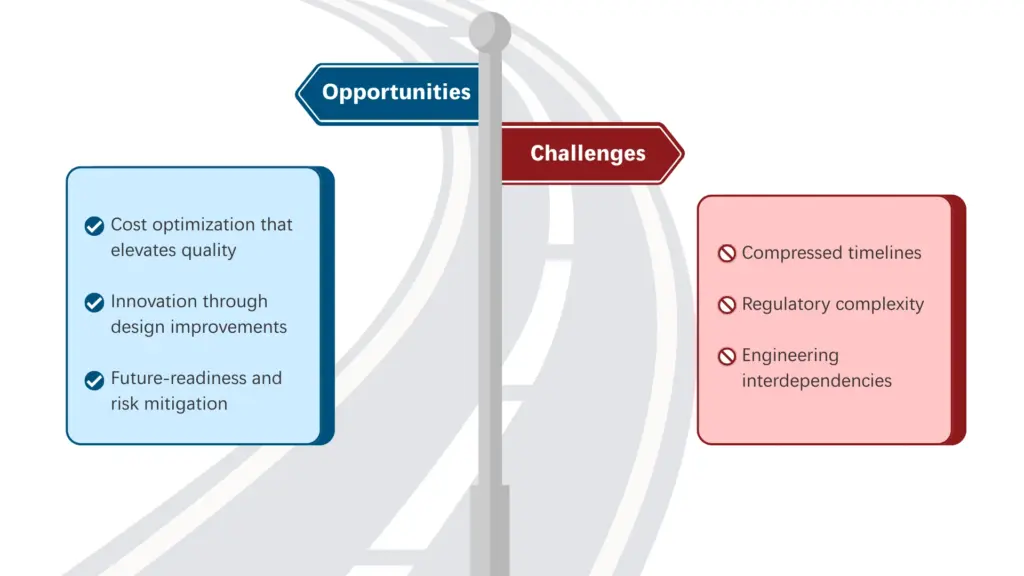
When deployed successfully, Value Analysis and Value Engineering in medical devices empowers medical device companies to –
- Drive cost optimization by re-engineering devices for leaner BOMs (Bill of Materials), more efficient PCBAs (PCB Assemblies), and lower lifecycle costs, without compromising function or safety.
- Enhance reliability and compliance by aligning components, materials, and assemblies with current regulatory standards and validated supply chains.
- Extend product lifecycles through smart redesigns that maintain clinical relevance while modernizing performance and manufacturability.
- Mitigate supply chain risk by proactively identifying and replacing EOL (end-of-life) parts with form-fit-function-compliant alternatives.
- Future-proof device platforms by updating embedded systems, mechanical assemblies, and electronics to meet next-generation manufacturing and connectivity expectations.
- Fuel innovation through redesign opportunities that improve usability, reduce part complexity, and unlock access to new global markets.
While doing so, MedTech leaders must carefully navigate critical challenges such as:
- Tighter integration across hardware, firmware, and UI layers, where even small changes can cascade into validation, usability, or cybersecurity implications.
- Compressed timelines driven by market demands and regulatory expectations that often leave little room for iterative redesign.
- Layered and evolving regulatory requirements that demand rigorous documentation, traceability, and change control across the product lifecycle.
Best Practices for Maximizing Value Engineering Benefits
To maximize the benefits of Value Analysis and Value Engineering, medical device leaders must understand its finer nuances and best practices, including:
- Prioritizing high-impact SKUs where redesign can yield measurable cost, compliance, or performance gains without triggering re-approval or revalidation hurdles.
- Embedding cross-functional collaboration early, bringing together R&D, Quality, Regulatory, Supply Chain, and Clinical teams to ensure changes are both viable and in compliance with audit requirements.
- Applying risk-based design controls, ensuring all Value Engineering initiatives align with ISO 14971:2019, Design History File (DHF) expectations, and do not compromise intended use or essential performance.
- Leveraging digital twins, simulation, and DFX (Design for Excellence) tools to accelerate analysis, reduce prototype cycles, and ensure manufacturing-readiness.
- Maintaining robust change control documentation to satisfy global regulatory requirements, especially for legacy device updates that may cross the threshold of significant change.
- Tracking and quantifying VAVE outcomes, not just in cost savings but also in improved reliability, risk reduction, and market competitiveness.
The Cross-Functional Nature of Value Engineering in Medical Devices
Effective product sustenance demands cross-functional ownership across every phase of the medical device lifecycle, from engineering and risk to regulatory and supply chain.
- R&D: Reverse engineering, tooling redesign, DFM improvements
- QARA: Risk management, submission strategy, DHF/DMR traceability
- Supply Chain: Obsolescence planning, second-sourcing, AVL expansion
- Post-Market Surveillance: Complaint trend analysis, CAPA input
- Manufacturing: Test fixture rework, yield analysis, packaging updates
Value Engineering in MedTech: Myths vs. Facts
Despite its critical role in lifecycle management, Value Engineering is often not fully understood and utilized, even within established MedTech organizations. Below is a breakdown of common misconceptions and the operational realities behind them:
| Myth | Fact |
| VAVE is just a cost-cutting initiative | VAVE is a strategic tool to optimize risk, quality, compliance, and long-term value across the product lifecycle. |
| VAVE is a one-time redesign effort | VAVE is an ongoing process, tightly integrated with Post-Market Surveillance (PMS), CAPA actions, and sustenance engineering. |
| VAVE is solely an engineering function | Effective VAVE demands a cross-functional approach, incorporating inputs from Quality Assurance (QA), Regulatory Affairs (RA), Supply Chain, and Design for Manufacturability (DFM) teams. |
| VAVE compromises product quality or performance | When executed with design controls and risk management, VAVE can enhance usability, reliability, and audit readiness, making the device stronger, not weaker. |
Syrma Johari MedTech’s VAVE Framework: Built for Real-World Execution
In the medical device industry, engineering, QARA, and product sustenance teams face mounting pressure, from shrinking timelines to increasing regulatory complexity.
Syrma Johari MedTech’s 3-step VAVE framework addresses these demands head-on. Grounded in engineering precision and regulatory insight, it enables focused redesigns that avoid requalification delays, prevent supply disruptions, and uphold product quality.
Step 1: BOM & Functional Teardown
- ABC cost segmentation to identify cost-heavy subsystems
- RoHS/REACH/EOL risk mapping for proactive obsolescence control
- Functional deconstruction of enclosures, PCBs, and firmware to pinpoint design inefficiencies
Step 2: Cost-Value Optimization Planning
- Should-cost benchmarking to challenge pricing and sourcing assumptions
- Prioritization of redesigns based on regulatory risk and ROI
- UI/UX alignment and platform harmonization across SKUs and markets
Step 3: Execution & Compliance Road mapping
- Controlled design changes with qualification protocols
- Full traceability via DHF/DMR updates, PMS file links, and change history
- Regulatory readiness for EU MDR Annex I/II, 510(k) supplements, and ISO 14971 updates
This is a proven, quarter-on-quarter implementation model built with medical device leaders, designed to align engineering decisions with compliance requirements and market growth objectives.
Four Pillars of Value Engineering at Syrma Johari MedTech
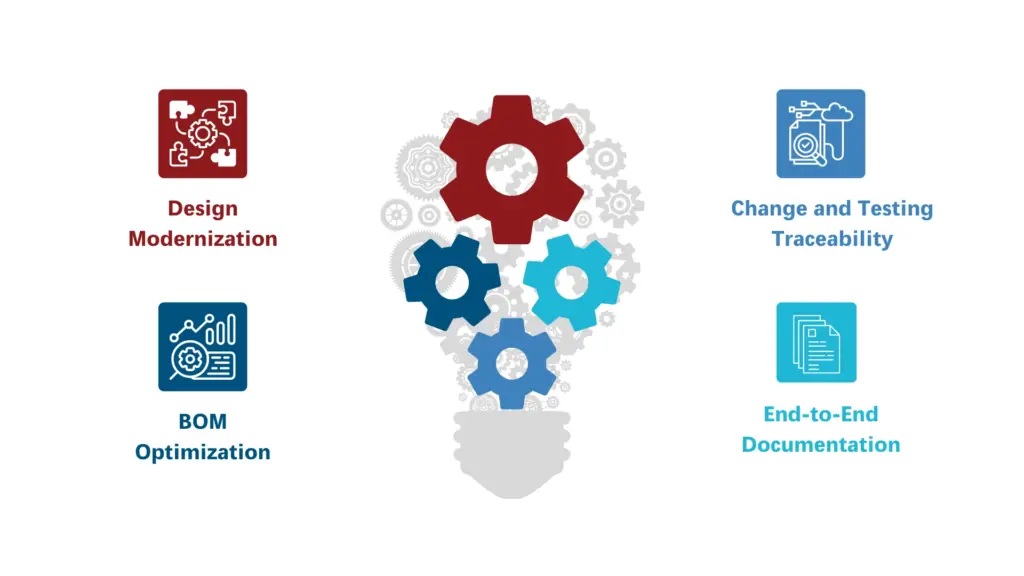
1. Design Modernization: Re-Engineer for Relevance
Legacy systems often carry the weight of outdated schematics, unsupported firmware, and expired tooling, all of which increase sustenance costs and delay change adoption. Syrma Johari MedTech’s modernization solutions go beyond patchwork fixes:
- Reverse engineering of legacy firmware, outdated 3D CAD, and 2D drawings
- Bootloader optimization and software migration for embedded platforms
- Geometry optimization via FEA to correct mechanical wear and improve structural integrity
- Tooling rework or replacement to align with next-gen manufacturing environments
Value Delivered: Enables QARA and R&D teams to extend the lifecycle without full requalification. Modernization reduces the cost of sustaining legacy SKUs while retaining design intent.
2. BOM Optimization & Obsolescence Management: Secure the Supply Chain
In today’s market, component availability can become a major compliance risk. Syrma Johari MedTech’s approach helps medical device companies actively manage this risk:
- Redesigns for End-of-Life components using form-fit-function substitutes
- Alternate material validation and second-source vendor qualification
- Lifecycle risk scoring of critical passives/actives
- AVL expansion mapped to risk registers and component volatility
Value Delivered: Prevents revenue disruption due to supply chain bottlenecks or forced last-time buys. Reduces cost spikes while ensuring compliance with RoHS/REACH and FDA traceability expectations.
3. Integration, Testing & Change Traceability: Scale Without Surprises
Every design change requires a validation plan that survives regulatory scrutiny. We embed change management into the sustaining process:
- PCBA re-layouts for space constraints, EMI/EMC, and thermal efficiency
- Custom fixture development for new firmware, mechanical interfaces, and test logic
- Revalidated test protocols (V&V, functional, environmental)
- Full Engineering Change Control (ECO/ECR) traceability integrated with DHF, DMR, and BOM
Value Delivered: Delivers production-grade reliability with minimal disruptions. Maintains audit compliance and ensures that traceability is preserved across the product lifecycle.
4. Documentation, Compliance & Submission Readiness: Engineer for Audit Resilience
When sustaining products across global markets, documentation is a revenue enabler. Syrma Johari MedTech’s regulatory compliance support closes gaps before they become roadblocks:
- Engineering file migration to modern ECAD/MCAD tools
- Realignment of DHF/DMR with actual as-built conditions
- PMS-ready traceability for MDR Annex II, FDA QSR, and ISO 13485:2016 submissions
- Proactive remediation for legacy SKUs under evolving global regulatory regimes
Value Delivered: Reduces documentation debt, accelerates review timelines, and increases confidence during inspections, audits, and change approvals.
Across each pillar, Syrma Johari MedTech combines hands-on engineering execution with deep regulatory fluency, so product sustenance doesn’t become a bottleneck to scale.
Real-World Impact: 5 Generations of Lifecycle Success
Over a 15-year partnership, Syrma Johari MedTech collaborated with a U.S.-based global medical device company specializing in DNA/RNA extraction systems. What started as a single generational refresh grew into a five-cycle transformation across design, firmware, user experience, and compliance architecture.
Initial Challenges:
- Enclosure and mechanical housing designed for Gen 1 manufacturing constraints
- Safety and user experience issues flagged via PMS and customer feedback
- Escalating manufacturing costs due to BOM sprawl and unavailable components
- No cloud-connectivity or intelligence features to meet modern lab standards
Our Approach:
- Conducted a full functional teardown of legacy design and control firmware
- Re-engineered shock mounts, dampers, and thermal modules to improve stability
- Updated UI/UX, adding touch interface and better safety interlocks
- Migrated to smart motor architecture with load sensing and Gen 6 cloud sync
Results Delivered:
- Achieved over 30% BOM cost reduction through VAVE-led redesign
- Enabled global scalability, 12,000+ units shipped across U.S., EU, and APAC
- Maintained RPM accuracy at 5500+ with proprietary 3D motion balancing
- Built-in obsolescence mitigation plan and lifecycle roadmap through 2030
Through 15+ years of partnership, we co-created a benchmark in the life science industry for its performance and aesthetics
Drive Continuous MedTech Growth with Expert-Led Value Engineering
Amid rising cost pressures, regulatory complexity, and supply chain volatility, VAVE enables MedTech teams to stay efficient and adaptable. Syrma Johari MedTech helps medical device companies modernize legacy platforms, reduce lifecycle costs, and meet global regulatory expectations, without sacrificing speed, quality, or scalability.
With extensive experience across surgical, diagnostic, and therapeutic devices, we deliver execution-focused Value Engineering programs built for complex sustenance needs.
✓ Integrated design, regulatory compliance, and manufacturing
✓ ISO 13485:2016, MDSAP, and FDA QSR certified